Field Pussytoes. Prairie everlasting.
Antennaria neglecta
Species Identification
Information needed to identify the plant in the field
Native-MIFlora:
Native
Duration:
perennial
Height:
1'
Stature:
Ankle
Bloom Color:
White
Compact Bloom Range:
APR - JUN
Light:
Sn, P
Moisture:
D, M
Michigan Flora Description:
Primarily in dry open ground, including sandy savanna, fields, prairies; grassy hillsides; apparently restricted in Michigan to the southern Lower Peninsula. Bayer has identified as A. neglecta two staminate individuals from barrens in Crawford Co. (on a mixed sheet with A. howellii subsp. petaloidea ). The mixed collection plus the distribution is suspicious. Likewise, a staminate collection from Marquette Co., labeled some 30 years after its 1894 collection date (no collector stated) is highly suspicious on geographic grounds and a mixing of labels (or specimens) is suspected. These records are not mapped. As here defined, this is a sexually reproducing diploid species. Staminate clones are frequent.
Germination Ecology / Real-World Behavior:(ⓘ Prompt)
Field pussytoes produces fluffy white achenes (small dry seeds) with tufts of white hair that are dispersed by wind in late spring to early summer. The seeds require cold stratification to break dormancy - they need prolonged cold, moist conditions over winter to germinate the following spring. In nature, seeds are scattered in late spring/early summer and lie dormant through winter, experiencing natural freeze-thaw cycles that condition them for germination. Seeds typically germinate in spring after experiencing several months of cold temperatures. The species also spreads vegetatively through horizontal stolons (above-ground runners) that root at nodes and form new colonies, which is often the primary means of reproduction and spread.
Based on genus patterns: Antennaria neglecta seeds disperse in late spring to early summer when fluffy white pappus structures catch wind currents. Seeds exhibit physiological dormancy requiring cold-moist stratification over winter months to break dormancy mechanisms. Based on life-history patterns: As a spring ephemeral, natural germination occurs in early spring when soil temperatures warm and day length increases, triggered by the combination of stratification completion and warming soil. Seeds that disperse in summer typically remain dormant through the hot season and germinate the following spring after experiencing winter chilling.
Habitat Notes:(ⓘ Prompt)
Field pussytoes grows in dry open ground including sandy savannas, fields, prairies, and grassy hillsides throughout southern Lower Peninsula Michigan. This small perennial spreads by runners and forms colonies, with individual plants producing either male or female flowers. The seeds develop fluffy white tufts (pappus) that catch the wind for dispersal. When mature, these lightweight seeds with their parachute-like attachments are carried away from the parent plant by even gentle breezes, allowing the species to colonize new patches of suitable dry, open habitat.
Field pussytoes also thrives in open woodlands, savannas, clay prairies, shale glades, roadsides, and rocky or ledge areas. It tolerates both clay and loamy soils and flourishes in mesic to dry conditions with partial to full sun. The species is allelopathic, releasing chemicals that can reduce the height of neighboring grasses and other plants, helping it maintain its colonies. Seeds are distributed primarily by wind, with the fluffy white pappus hairs (6-9mm long) acting as parachutes that carry the small brown seeds away from parent plants during late spring to early summer.
Based on genus patterns: Antennaria species typically inhabit dry to mesic open areas including prairies, old fields, sandy or gravelly soils, and woodland edges with full to partial sun. Based on species patterns: A. neglecta specifically favors disturbed sites, roadsides, and areas with well-drained soils across the Great Lakes region. Based on family patterns: Seeds are equipped with white pappus (fluffy bristles) that enable wind dispersal, with mature seed heads releasing small achenes that can travel considerable distances on air currents during late summer through fall.
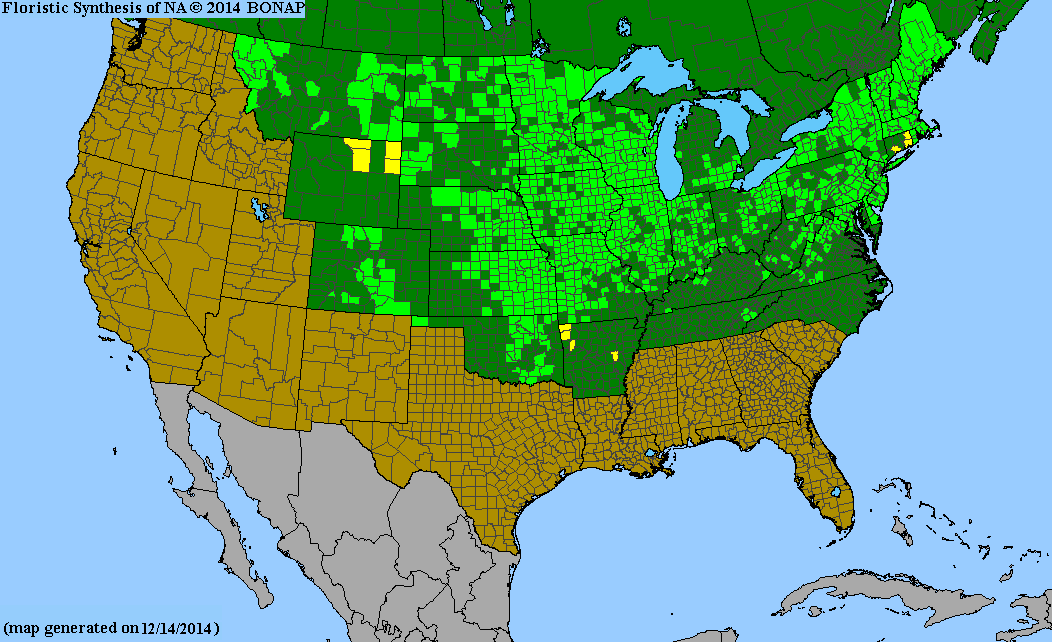
BONAP Range Map:
SE Michigan Monthly Observations:
Previously Known As:
Antennaria angustiarum, Antennaria athabascensis, Antennaria campestris, Antennaria chelonica, Antennaria erosa, Antennaria longifolia, Antennaria lunellii, Antennaria nebrascensis, Antennaria nebraskensis
Common Names:
field pussytoes, field pussy-toes, cat's foot, cat's-foot, ladies' tobacco, lady's tobacco
Coefficient of Conservatism (C):
3.0
— Adaptable
This plant can grow in many different settings, including areas that have been somewhat changed by human activity.
Explained
Coefficient of Wetness (CW):
5.0
— Needs dry ground
This plant almost never grows in wetlands. It needs well-drained soil and can rot in soggy conditions.
Explained
Similar Species / Distinguishing Features:(ⓘ Prompt)
• Native — **Antennaria howellii** (Howell's pussytoes): plants without the two defining features of A. neglecta: with either the upper stem leaves merely pointed or new rosette leaves bright green and without hairs on the upper surface (vs. A. neglecta, which combines upper stem leaves terminated by a flat or curling, weak-textured appendage and new rosette leaves gray-green with woolly hairs on the upper surface).
• Native — **Antennaria plantaginifolia** (plantain-leaved pussytoes): has wider basal leaves with 3 prominent parallel veins compared to A. neglecta's narrower leaves with 1-2 prominent veins.
• Native — **Antennaria parvifolia** (small-leaved pussytoes): plants are smaller, rarely taller than 4 inches, with smaller basal leaves (all less than 1½ inches long) that are more silvery green from denser hairs.
• Native — **Antennaria microphylla** (tiny-leaved pussytoes): has the smallest basal leaves of the one-veined group, the largest less than ⅔ inch long but most ½ inch or less.
• Native — **Antennaria rosea** (rosy pussytoes): similar to A. parvifolia but has taller stems and phyllaries (bracts around flower heads) are often rosy pink.
• Native — **Antennaria plantaginifolia** (plantain-leaved pussytoes): has wider basal leaves with 3 prominent parallel veins compared to A. neglecta's narrower leaves with 1-2 prominent veins.
• Native — **Antennaria parvifolia** (small-leaved pussytoes): plants are smaller, rarely taller than 4 inches, with smaller basal leaves (all less than 1½ inches long) that are more silvery green from denser hairs.
• Native — **Antennaria microphylla** (tiny-leaved pussytoes): has the smallest basal leaves of the one-veined group, the largest less than ⅔ inch long but most ½ inch or less.
• Native — **Antennaria rosea** (rosy pussytoes): similar to A. parvifolia but has taller stems and phyllaries (bracts around flower heads) are often rosy pink.
• Based on genus patterns:
• Native — Antennaria plantaginifolia (plantain-leaved pussytoes) has broader, more oval basal leaves compared to the narrower leaves of A. neglecta, and typically grows in woodlands rather than open areas.
• Native — Antennaria parlinii (Parlin's pussytoes) is very similar but has slightly different leaf shapes and may have different flowering times. Based on family patterns:
• Native — Gnaphalium species (cudweeds) share the woolly appearance and small whitish flower heads but typically have leafy stems rather than the bare flowering stalks characteristic of Antennaria. Based on general practice: Distinguishing between Antennaria species often requires close examination of leaf shape, hairiness patterns, and habitat preferences, as the flower heads are quite similar across the genus.
• Native — Antennaria plantaginifolia (plantain-leaved pussytoes) has broader, more oval basal leaves compared to the narrower leaves of A. neglecta, and typically grows in woodlands rather than open areas.
• Native — Antennaria parlinii (Parlin's pussytoes) is very similar but has slightly different leaf shapes and may have different flowering times. Based on family patterns:
• Native — Gnaphalium species (cudweeds) share the woolly appearance and small whitish flower heads but typically have leafy stems rather than the bare flowering stalks characteristic of Antennaria. Based on general practice: Distinguishing between Antennaria species often requires close examination of leaf shape, hairiness patterns, and habitat preferences, as the flower heads are quite similar across the genus.
Wikipedia Summary:
Antennaria neglecta is a North American species of flowering plants in the daisy family known by the common name field pussytoes. It is widespread across much of Canada (including Northwest Territories plus all provinces except Newfoundland/Labrador) as well as the northeastern and north-central United States.