Spikenard
Aralia racemosa
Species Identification
Information needed to identify the plant in the field
Native-MIFlora:
Native
Duration:
perennial
Height:
2'-5'
Stature:
Chest
Bloom Color:
White
Compact Bloom Range:
JUN - AUG
Light:
P, Sh
Moisture:
M, Ms, W
Michigan Flora Description:
Rich usually moist beech-maple and hemlock-hardwoods, especially along edges and clearings and below bluffs; less often in oak forests; conifer (mostly cedar) swamps. This is one of the largest herbaceous species in our flora, widely spreading and bushy, with enormous compound leaves and a massive inflorescence of countless umbels of purple-black fruit. There are often smaller axillary inflorescences as well. The individual umbels in this species are usually less than 2.5 cm broad, though occasionally almost 3 cm in fruit.
Germination Ecology / Real-World Behavior:(ⓘ Prompt)
Seeds ripen in late summer to early fall and are dispersed by wildlife including birds like Swainson's thrush and mammals like black bears that consume the purple-red berries. Seeds require cool-moist stratification to break dormancy and naturally germinate the following spring after experiencing winter conditions. The berry flesh contains germination inhibitors that must break down over time or be removed for successful germination.
Based on genus patterns: Seeds ripen in late summer to early fall and are dispersed by birds that consume the dark purple berries. Based on family patterns: Seeds typically have complex dormancy requiring both warm and cold stratification periods to break down the hard seed coat and immature embryo. Based on general practice: Natural germination usually occurs after 18-24 months, with seeds experiencing one warm season followed by winter cold, then germinating the second spring. Based on species patterns: Seeds may remain viable in the soil for multiple years if germination conditions aren't met, allowing for irregular recruitment when canopy gaps or other favorable conditions develop.
Habitat Notes:(ⓘ Prompt)
Spikenard grows in rich, usually moist beech-maple and hemlock-hardwood forests throughout Michigan, especially along forest edges, clearings, and below bluffs. It also occurs in oak forests and conifer swamps dominated by cedar. The plant produces large clusters (umbels) of purple-black fruit that are arranged in massive branching flower clusters, with smaller additional clusters often growing from the leaf joints. Birds are likely the primary dispersers of these fleshy, dark berries, carrying them to new forest locations where they can establish in suitable rich, moist woodland soils.
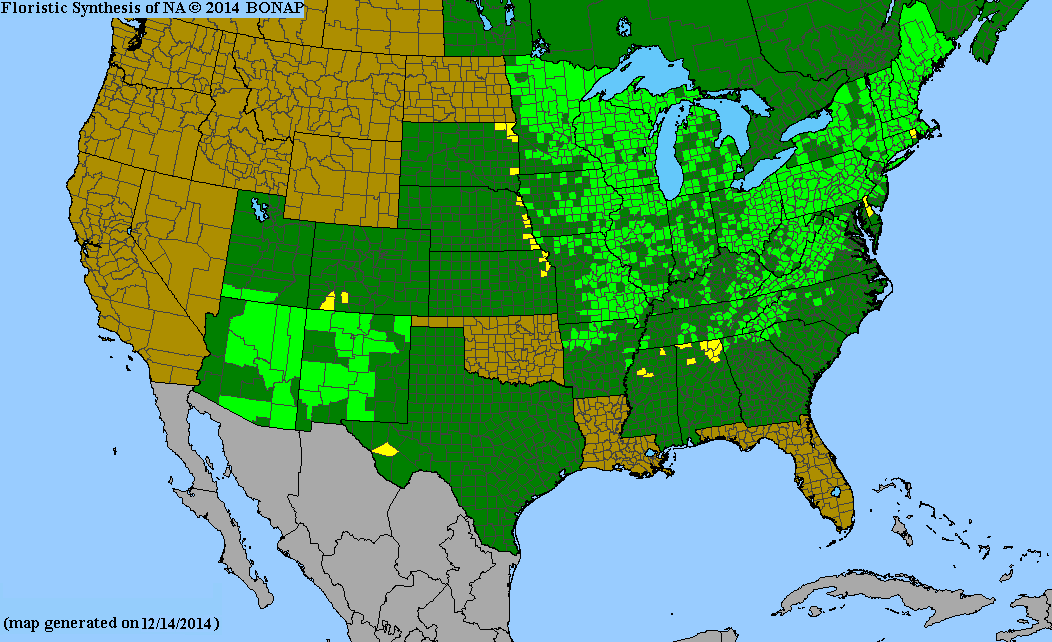
Spikenard is found in moist deciduous forests across a broad geographic range extending from New Brunswick to Manitoba and south to Georgia, northern Arkansas, and northeast Kansas. The species also occurs in oak woodlands and can tolerate significant shade. Wildlife extensively utilizes the purple-red berries - both birds like Swainson's Thrush and mammals including American Black Bears consume the fruit, with bears documented feeding on spikenard berries in Minnesota forests.
Based on species patterns: Aralia racemosa typically occurs in rich, moist deciduous woodlands and forest edges with partial to deep shade. Based on genus patterns: Prefers well-drained but consistently moist soils with high organic content, often found on slopes or near woodland streams. Based on species patterns: Seeds are contained in small purple-black berries that ripen in late summer to early fall, dispersed primarily by birds that consume the fleshy fruits. Based on family patterns: The berries are arranged in large compound clusters, making them attractive to various songbirds and small mammals that scatter seeds through their droppings.
BONAP Range Map:
SE Michigan Monthly Observations:
Common Names:
American Spikenard, Spikenard, Life-of-man, Pettymorrel, Indian Root, Spice Berry, Spignet
Coefficient of Conservatism (C):
8.0
— Needs quality habitat
This plant is choosy about where it lives. It strongly prefers natural areas that haven't been heavily disturbed.
Explained
Coefficient of Wetness (CW):
3.0
— Prefers dry conditions
This plant usually grows in well-drained, drier upland areas and may struggle in wet soils.
Explained
Similar Species / Distinguishing Features:(ⓘ Prompt)
• Native — Wild Sarsaparilla (Aralia nudicaulis) has smaller compound leaves that are closer to the ground, single flower clusters rather than multiple branched clusters, and grows much shorter (1-2 feet vs 3-6 feet).
• Native — Elder species (Sambucus canadensis) can have similar large compound leaves and clustered berries, but elder has opposite leaves while spikenard has alternate leaves, and elder is a true woody shrub.
• Horticultural — Japanese Angelica (Angelica gigas) has similar large compound leaves and umbel flower clusters but typically has dark purple stems and different leaf arrangement.
• Non-native — Japanese Knotweed (Fallopia japonica) can appear similar due to its large size and broad growth habit, but has simple heart-shaped leaves rather than compound leaves, and hollow jointed stems.
• Native — Elder species (Sambucus canadensis) can have similar large compound leaves and clustered berries, but elder has opposite leaves while spikenard has alternate leaves, and elder is a true woody shrub.
• Horticultural — Japanese Angelica (Angelica gigas) has similar large compound leaves and umbel flower clusters but typically has dark purple stems and different leaf arrangement.
• Non-native — Japanese Knotweed (Fallopia japonica) can appear similar due to its large size and broad growth habit, but has simple heart-shaped leaves rather than compound leaves, and hollow jointed stems.
• Based on genus patterns:
• Native — Aralia spinosa (devil's walking stick) has woody stems with prominent spines versus herbaceous stems in A. racemosa.
• Native — Aralia nudicaulis (wild sarsaparilla) is much smaller with typically 3 leaflets per compound leaf versus the large, multiply-compound leaves.
• Native — Panax quinquefolius (American ginseng) has palmate leaves versus pinnately compound leaves and grows much smaller.
• Native — Actaea species (baneberries) have similar compound leaves but produce dense clusters of white berries versus loose clusters of dark purple berries. Based on family patterns:
• Native — Heracleum maximum (cow parsnip) in Apiaceae has similar large compound leaves but umbel flower clusters versus panicles.
• Native — Aralia spinosa (devil's walking stick) has woody stems with prominent spines versus herbaceous stems in A. racemosa.
• Native — Aralia nudicaulis (wild sarsaparilla) is much smaller with typically 3 leaflets per compound leaf versus the large, multiply-compound leaves.
• Native — Panax quinquefolius (American ginseng) has palmate leaves versus pinnately compound leaves and grows much smaller.
• Native — Actaea species (baneberries) have similar compound leaves but produce dense clusters of white berries versus loose clusters of dark purple berries. Based on family patterns:
• Native — Heracleum maximum (cow parsnip) in Apiaceae has similar large compound leaves but umbel flower clusters versus panicles.
Wikipedia Summary:
Aralia racemosa, with common names American spikenard, small spikenard, Indian root, spice berry, spignet, life-of-man, petty morel, is an ornamental plant in the Araliaceae family native to the United States and Canada. It is a herbaceous plant, about one to two meters tall, which grows in shady areas. Its native range includes most of the eastern United States.