Poke Milkweed
Asclepias exaltata
Species Identification
Information needed to identify the plant in the field
Native-MIFlora:
Native
Duration:
perennial
Height:
2'-3'
Stature:
Waist
Bloom Color:
White
Compact Bloom Range:
JUN - JUL
Light:
P, Sh
Moisture:
D, M
Michigan Flora Description:
This is our only truly forest understory species, usually in dry or rocky forests and savannas with oaks and other trees such as hickory, pine, and aspen; banks and borders, even roadsides; much less often in rich beech-maple forests or swamps. The leaf blades are glaucous beneath, rather thin in texture, broadly elliptic, and somewhat acuminate at both ends. They resemble the leaves of Phytolacca (pokeweed), and the species has been known as A. phytolaccoides Pursh. This is a graceful woodland species, quite attractive when well grown.
Germination Ecology / Real-World Behavior:(ⓘ Prompt)
Poke milkweed seeds ripen in late summer to fall inside large follicles (seed pods) that are 4-6 inches long. The follicles split open along one side during fall to release flat brown seeds, each with a tuft of white hairs that allows wind dispersal. Seeds require cold stratification - a period of cold, moist conditions over winter - to break dormancy and prepare for germination. In nature, seeds disperse in fall, experience winter's cold and moisture, then germinate the following spring after soil warms. This dormancy mechanism prevents seeds from germinating before winter frosts that would kill seedlings.
Based on genus patterns: Seeds disperse in late fall when follicles split open, releasing wind-carried seeds with white silky pappus. Based on family patterns: Seeds typically exhibit physiological dormancy requiring cold-moist stratification to break dormancy mechanisms. Based on genus patterns: Natural germination occurs in spring after winter conditioning, with seeds responding to warming soil temperatures and increasing day length. Seeds may remain dormant in the soil for multiple seasons if conditions aren't suitable. Based on general practice: Germination is typically improved by consistent moisture and may require light exposure, though some seeds can germinate under light leaf litter in woodland settings.
Habitat Notes:(ⓘ Prompt)
Poke milkweed is Michigan's only truly forest understory milkweed species, typically found in dry or rocky forests and savannas with oaks, hickory, pine, and aspen. It grows along banks, borders, and even roadsides, though much less often in rich beech-maple forests or swamps. This shade-tolerant species prefers open woodlands and savannas with mesic, well-draining soils. Like other milkweeds, seeds are dispersed by wind using their fluffy white attachments (pappus) that act like parachutes, allowing them to travel considerable distances from the parent plant when released from split pods.
Additional sources confirm poke milkweed's preference for woodland edges, forest openings, and rich mesic woodlands with organic matter. It also occurs in sandy woodlands, upland rocky woodlands, wooded slopes, and paths through woodlands. This species thrives in partial to full shade with moderate moisture and rich organic soil content. Seeds develop in spindle-shaped pods (follicles) 4-6 inches long covered in downy hairs that split open along one side in fall to release flat brown seeds, each with a tuft of long white hair for wind dispersal.
Based on genus patterns: Poke milkweed typically inhabits woodland edges, clearings, and partially shaded areas with rich, moist soils. Based on species patterns: Unlike many Asclepias species that prefer full sun, this species tolerates and often prefers partial shade conditions. Based on family patterns: Seeds develop in elongated follicles that split open when mature, releasing seeds with silky white pappus structures. Based on genus patterns: The fluffy pappus catches wind currents, allowing seeds to disperse considerable distances from the parent plant in late summer to early fall.
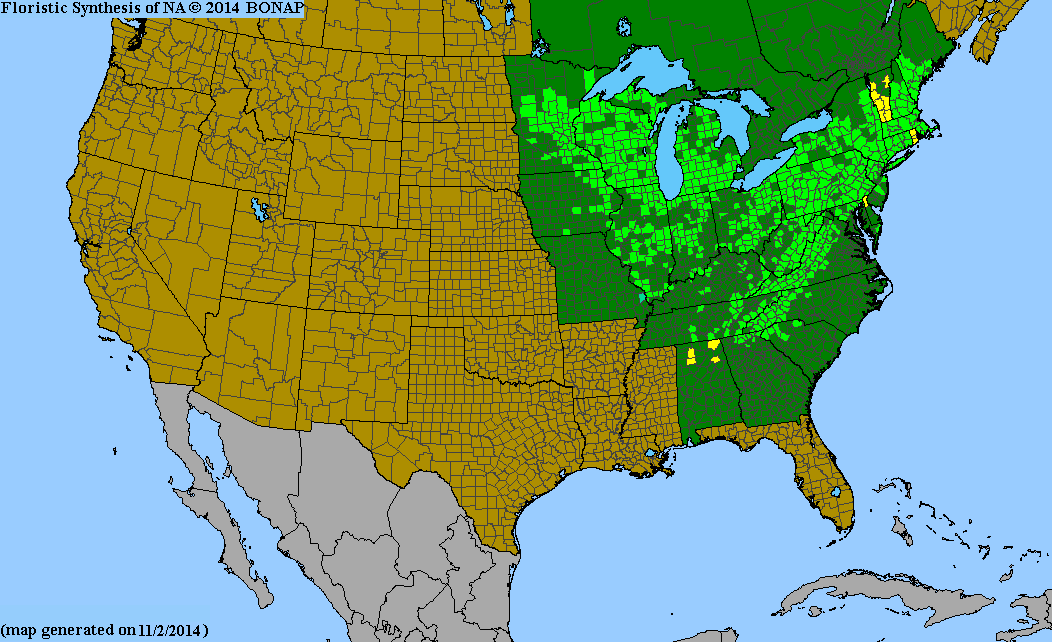
BONAP Range Map:
SE Michigan Monthly Observations:
Previously Known As:
Asclepias bicknellii, Asclepias nivea, Asclepias phytolaccoides, Asclepias phytolaccoides
Common Names:
poke milkweed, tall milkweed, forest milkweed
Coefficient of Conservatism (C):
6.0
— Prefers natural areas
This plant does best in natural areas but can handle some changes to its environment. Finding it suggests the habitat is in decent shape.
Explained
Coefficient of Wetness (CW):
5.0
— Needs dry ground
This plant almost never grows in wetlands. It needs well-drained soil and can rot in soggy conditions.
Explained
Similar Species / Distinguishing Features:(ⓘ Prompt)
• Native — Purple milkweed (Asclepias purpurascens) has similar large leaves but grows in full sun prairies and fields rather than shaded woodlands, and has purple-red flowers instead of white and green flowers.
• Native — Butterfly weed (Asclepias tuberosa) has similar slender, elongated seed pods but grows in sunny, dry sites and has bright orange flowers rather than white and green woodland flowers.
• Native — Pokeweed (Phytolacca americana) has very similar leaf shape and size, which is why poke milkweed was once called A. phytolaccoides, but pokeweed lacks milky sap and has purple-black berries instead of milkweed pods with fluffy seeds.
• Native — Butterfly weed (Asclepias tuberosa) has similar slender, elongated seed pods but grows in sunny, dry sites and has bright orange flowers rather than white and green woodland flowers.
• Native — Pokeweed (Phytolacca americana) has very similar leaf shape and size, which is why poke milkweed was once called A. phytolaccoides, but pokeweed lacks milky sap and has purple-black berries instead of milkweed pods with fluffy seeds.
• Native — Common milkweed (Asclepias syriaca) is equally tall and has similar large leaves, but grows in full sun prairies and fields rather than shaded woodlands, has pink-purple flowers in dense rounded clusters instead of drooping white and green clusters, and has been known to hybridize with poke milkweed where both occur in close proximity.
• Native — Swamp milkweed (Asclepias incarnata) is also equally tall but grows in wet sunny areas like marshes and stream edges rather than shaded woodlands, and has rose-pink flowers in upright clusters instead of drooping white and green flowers.
• Native — Swamp milkweed (Asclepias incarnata) is also equally tall but grows in wet sunny areas like marshes and stream edges rather than shaded woodlands, and has rose-pink flowers in upright clusters instead of drooping white and green flowers.
• Based on genus patterns:
• Native — Asclepias speciosa (showy milkweed) has broader, more oval leaves and larger, showier pink flower clusters, typically found in more open habitats.
• Native — Asclepias incarnata (swamp milkweed) has narrower leaves and bright pink flowers, preferring wetter soils than A. exaltata.
• Native — Asclepias syriaca (common milkweed) has broader, more pubescent leaves and larger pink flower clusters in more open areas. Based on family patterns:
• Native — Apocynum cannabinum (dogbane) has smaller white flowers and different leaf arrangement, but shares the milky sap characteristic.
• Native — Asclepias speciosa (showy milkweed) has broader, more oval leaves and larger, showier pink flower clusters, typically found in more open habitats.
• Native — Asclepias incarnata (swamp milkweed) has narrower leaves and bright pink flowers, preferring wetter soils than A. exaltata.
• Native — Asclepias syriaca (common milkweed) has broader, more pubescent leaves and larger pink flower clusters in more open areas. Based on family patterns:
• Native — Apocynum cannabinum (dogbane) has smaller white flowers and different leaf arrangement, but shares the milky sap characteristic.
Wikipedia Summary:
Asclepias exaltata is a species of flowering plant in the family Apocynaceae known by the common names poke milkweed and tall milkweed. It is native to eastern North America. It blooms from late spring to early summer. The flowers are green and white. Poke milkweed is found in moist woodland habitats. It grows in moist soil and sunny or partly shaded places. It grows from 0.6 to 1.5 meters (2.0 to 4.9 ft) tall.
Cloudinary Images - Identification
3 images

