Swamp/Rose Milkweed
Asclepias incarnata
Species Identification
Information needed to identify the plant in the field
Native-MIFlora:
Native
Duration:
perennial
Height:
3'-4'
Stature:
Waist
Bloom Color:
Pink-Purple
Compact Bloom Range:
JUL
Light:
P, Sh
Moisture:
M, Ms, W
Michigan Flora Description:
This is our only milkweed of truly wet ground, often in several centimeters of water: edges of rivers and streams; shores, wet prairies; openings in conifer swamps, fens (less often bogs); depressions in forests, swales and ditches, meadows. One of our showiest species in its deep color. The leaves are usually smaller and narrower than in A. exaltata , green (not glaucous) beneath. The flowers are rather variable in color, often a dusty, light pink, but occasionally a deep purple. White forms are rare.
Germination Ecology / Real-World Behavior:(ⓘ Prompt)
Swamp milkweed seeds have natural dormancy that requires cold/moist stratification to break before germination. In nature, seeds disperse in fall on fluffy white tufts and overwinter on the soil surface, where cold and moisture conditions gradually break dormancy. Seeds naturally germinate in spring after experiencing winter conditions. The species spreads both by wind-dispersed seeds and by developing clonal colonies from its rhizomatous root system.
Based on genus patterns: Seeds disperse in late fall when follicles split open, releasing wind-carried seeds with white silky pappus. Based on species patterns: Seeds require cold-moist stratification over winter to break physiological dormancy, with germination typically occurring in spring when soil temperatures warm. Natural germination happens after snowmelt when consistent moisture and warming temperatures provide optimal conditions. Based on family patterns: Seeds benefit from light exposure during germination, suggesting they naturally germinate near the soil surface rather than deeply buried.
Habitat Notes:(ⓘ Prompt)
Swamp milkweed is Michigan's only milkweed of truly wet ground, often growing in several centimeters of water along edges of rivers and streams, shores, wet prairies, openings in conifer swamps, fens, forest depressions, swales and ditches, and meadows. It's the primary milkweed species found in wetland habitats. The seeds are dispersed by wind using fluffy white structures called pappus (floss) that act like parachutes, carrying the brown seeds away from the parent plant when the finger-wide pods split open in fall.
Broader sources confirm swamp milkweed's preference for marshes, swamps, pond margins, shores of rivers and lakes, wet meadows, and wetland margins. It also grows in floodplain forests, bottomland prairies, moist black soil prairies, and drainage ditches. The plant tolerates occasional flooding if temporary and can thrive in mucky clay soils that challenge most other ornamentals. Seeds are released when the 3-4 inch follicles (seed pods) split open along one side, with each brown seed equipped with large white tufts that catch the wind for dispersal during fall.
Based on species patterns: Asclepias incarnata typically grows in wet meadows, marshes, swales, and along stream edges where soils remain consistently moist to wet. Based on family patterns: Seeds are equipped with silky white pappus (coma) that enables wind dispersal from follicles that split open along one seam when mature in late summer to fall. The large, flattened seeds with their feathery white plumes catch autumn winds and can travel considerable distances before settling, often germinating the following spring after experiencing winter's cold-moist conditions.
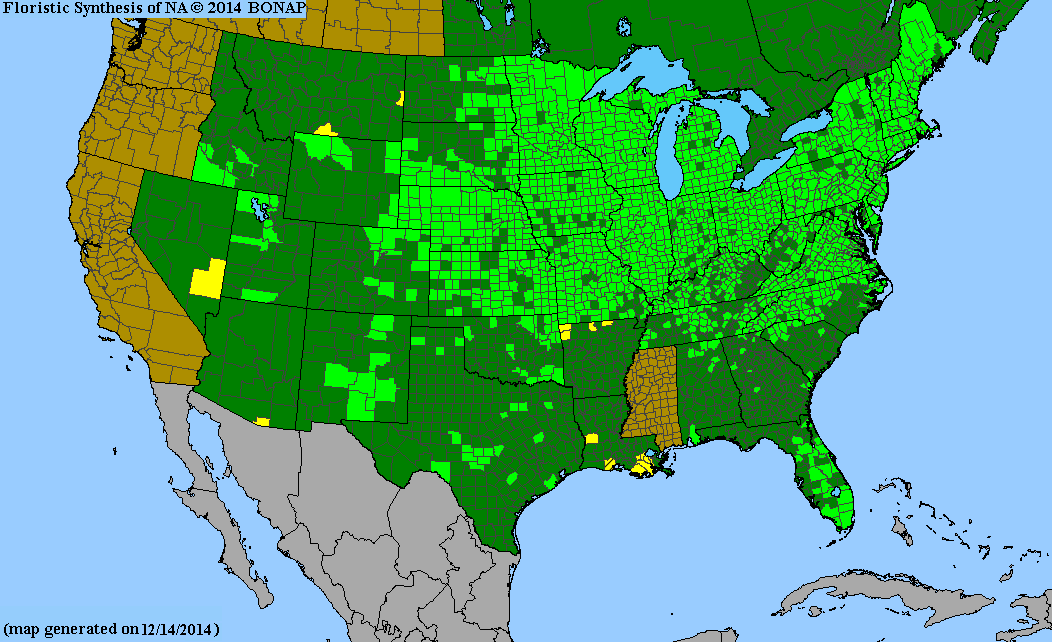
BONAP Range Map:
SE Michigan Monthly Observations:
Common Names:
swamp milkweed, rose milkweed, pink milkweed, marsh milkweed, white Indian hemp
Coefficient of Conservatism (C):
6.0
— Prefers natural areas
This plant does best in natural areas but can handle some changes to its environment. Finding it suggests the habitat is in decent shape.
Explained
Coefficient of Wetness (CW):
-5.0
— Loves wet feet
This plant almost always grows in wetlands. It thrives standing in water or saturated soil.
Explained
Similar Species / Distinguishing Features:(ⓘ Prompt)
• Native — Asclepias tuberosa (butterfly milkweed) has similar-sized seed pods, but the pods have peach fuzz while swamp milkweed pods are smooth.
• Native — Asclepias exaltata (poke milkweed) has leaves that are usually larger and broader than swamp milkweed, and the leaves are glaucous (bluish-white) beneath rather than green beneath.
• Native — Asclepias exaltata (poke milkweed) has leaves that are usually larger and broader than swamp milkweed, and the leaves are glaucous (bluish-white) beneath rather than green beneath.
• Native — Asclepias syriaca (common milkweed) has much wider leaves (2-6 inches wide vs swamp milkweed's narrow 0.5-1.5 inches wide) and prefers drier upland sites rather than wetlands.
• Native — Asclepias sullivantii (prairie milkweed) is shorter and less branched with wider leaves, typically found in drier prairie habitats.
• Native — Asclepias sullivantii (prairie milkweed) is shorter and less branched with wider leaves, typically found in drier prairie habitats.
• Based on genus patterns:
• Native — Asclepias speciosa (showy milkweed) has broader, more oval leaves and larger flower clusters, typically found in western regions but occasionally in Michigan.
• Native — Asclepias purpurascens (purple milkweed) has similar pink-purple flowers but broader leaves and drier habitat preferences.
• Native — Asclepias sullivantii (Sullivant's milkweed) has similar smooth leaves but typically grows in prairies rather than wetlands.
• Native — Asclepias exaltata (poke milkweed) is taller with white flowers and broader leaves in woodland settings.
• Horticultural — Cultivated Asclepias speciosa varieties may be planted in gardens and have showier, larger flower heads. Based on family patterns:
• Non-native — Apocynum species (dogbanes) have smaller, white or pale pink flowers and different leaf arrangement, but share the milky sap characteristic.
• Native — Asclepias speciosa (showy milkweed) has broader, more oval leaves and larger flower clusters, typically found in western regions but occasionally in Michigan.
• Native — Asclepias purpurascens (purple milkweed) has similar pink-purple flowers but broader leaves and drier habitat preferences.
• Native — Asclepias sullivantii (Sullivant's milkweed) has similar smooth leaves but typically grows in prairies rather than wetlands.
• Native — Asclepias exaltata (poke milkweed) is taller with white flowers and broader leaves in woodland settings.
• Horticultural — Cultivated Asclepias speciosa varieties may be planted in gardens and have showier, larger flower heads. Based on family patterns:
• Non-native — Apocynum species (dogbanes) have smaller, white or pale pink flowers and different leaf arrangement, but share the milky sap characteristic.
Wikipedia Summary:
Asclepias incarnata, the swamp milkweed, rose milkweed, rose milkflower, swamp silkweed, or white Indian hemp, is a herbaceous perennial plant species native to North America. It grows in damp to wet soils and also is cultivated as a garden plant for its flowers, which attract butterflies and other pollinators with nectar. Like most other milkweeds, it has sap containing toxic chemicals, a characteristic that repels insects and other herbivorous animals.
Cloudinary Images - Identification
2 images
