Downy Wood Mint
Blephilia ciliata
Species Identification
Information needed to identify the plant in the field
Native-MIFlora:
Native
Duration:
perennial
Height:
1'
Stature:
Ankle
Bloom Color:
Purple
Compact Bloom Range:
JUN - JUL
Light:
Sn, P
Moisture:
D, M
Michigan Flora Description:
Oak savannas and borders; thickets, banks, and clearings; meadows and barrens, borders of fens, thin soil over limestone. The broad appressed bracts in the inflorescence are suggestive of Prunella vulgaris , which (besides having 4 stamens) tends to have longer petioles and the upper lip of the calyx only shallowly 3-toothed instead of cleft into long copiously ciliate teeth.
Germination Ecology / Real-World Behavior:(ⓘ Prompt)
Downy wood mint produces small nutlets (1-1.2 mm long) that mature in summer after the early summer flowering period. The seeds are described as quite small and distributed by wind to some extent. As a member of the mint family producing small, dry nutlets, the seeds likely require some cold stratification over winter for spring germination, though specific dormancy mechanisms are not well documented. The plant spreads primarily through rhizomes from a central taproot, suggesting vegetative reproduction may be as important as seed dispersal for establishing new populations.
Based on genus patterns: Seeds disperse in late summer to early fall when flower heads dry and break apart. Based on family patterns: Seeds likely have physiological dormancy typical of Lamiaceae, requiring cold-moist stratification to break dormancy mechanisms. Based on general practice: Natural germination occurs in spring after winter conditioning, with seeds responding to warming soil temperatures and increased daylight. Seeds that fall in autumn typically remain dormant through winter, then germinate during the following growing season when temperature and moisture conditions become favorable.
Habitat Notes:(ⓘ Prompt)
Ohio horse mint grows in oak savannas and their borders, along with thickets, banks, and clearings throughout Michigan. It can also be found in meadows and barrens, borders of fens, and areas with thin soil over limestone. Seeds disperse close to the parent plant when shaken loose by wind or passing animals. The tiny black seeds fall from small tubes (calyx) that remain after the flowers drop off, creating a "mama's boy" dispersal pattern where new plants establish near their parent.
Downy wood-mint also grows in mesic to dry black soil prairies, dolomite prairies, limestone bluffs, limestone glades, and thin woods with granitic or limestone substrates. In Illinois, it's found most often in NE and west-central counties, preferring open areas more than woodlands despite its common name. The plant tolerates high pH and limestone soils, and has greater drought tolerance than most other mints.
Based on genus patterns: Blephilia ciliata typically grows in moist to mesic woodlands, woodland edges, and partially shaded areas with rich, loamy soils. Based on family patterns: As a member of the mint family (Lamiaceae), it produces small nutlets that mature in late summer and disperse primarily through gravity and local animal movement. Based on general patterns: The square stems and opposite leaves characteristic of mints help distinguish it from other woodland herbs, and it often forms small colonies through short rhizomes. Seeds fall close to the parent plant when nutlets drop from the dried flower spikes in fall.
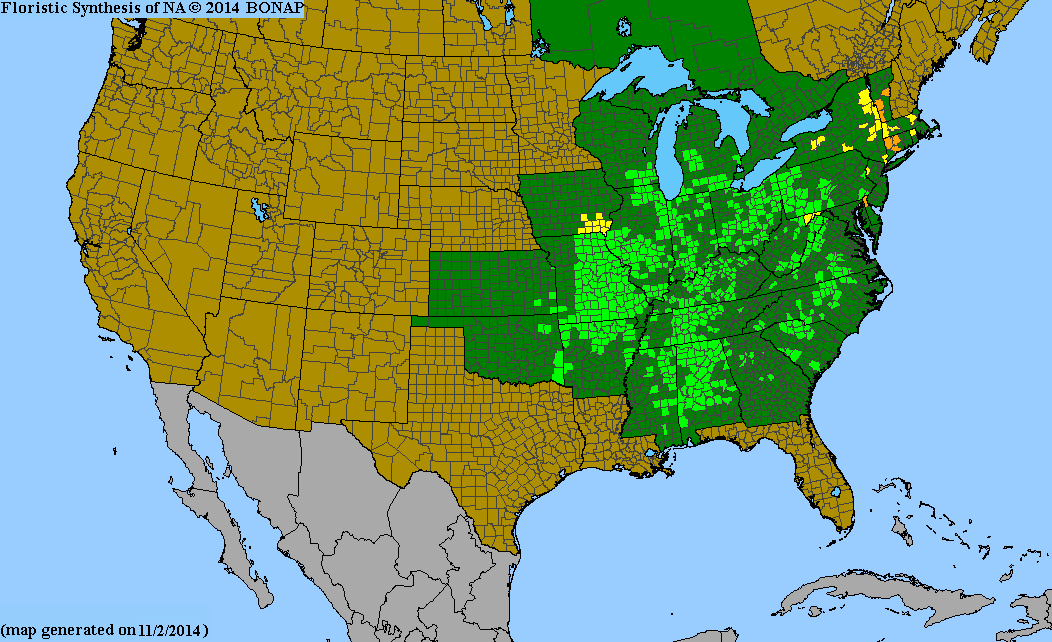
BONAP Range Map:
SE Michigan Monthly Observations:
External Reference URLs:
Previously Known As:
Blephilia beckii, Blephilia brevifolia, Blephilia heterophyla, Blephilia pratensis, Monarda beckii, Monarda ciliata
Common Names:
downy woodmint, downy wood mint, Ohio horsemint, downy pagoda plant
Coefficient of Conservatism (C):
7.0
— Needs quality habitat
This plant is choosy about where it lives. It strongly prefers natural areas that haven't been heavily disturbed.
Explained
Coefficient of Wetness (CW):
5.0
— Needs dry ground
This plant almost never grows in wetlands. It needs well-drained soil and can rot in soggy conditions.
Explained
Similar Species / Distinguishing Features:(ⓘ Prompt)
• Native — Prunella vulgaris (heal-all) has similar broad, flattened bracts in the flower cluster, but has only 4 stamens (instead of 2), longer leaf stems, and the upper part of the calyx (outer flower parts) is only shallowly 3-toothed rather than deeply split into long, fringed teeth.
• Native — Monarda species (wild bergamot, bee balm) are mint relatives that can look similar, but Ohio horse mint's flowers fall off to reveal distinctive tubes containing the seeds, and the overall flower head structure differs.
• Native — Monarda species (wild bergamot, bee balm) are mint relatives that can look similar, but Ohio horse mint's flowers fall off to reveal distinctive tubes containing the seeds, and the overall flower head structure differs.
• Native — Blephilia hirsuta (hairy wood mint) is the most similar species, but has long spreading hairs on its stems rather than short appressed hairs, grows taller (typically over 2 feet vs. 1-2 feet), and is more woodland-adapted while downy wood mint prefers open areas.
• Non-native — Various Eurasian mint species can be confused with this plant, though specific distinguishing features vary by species.
• Non-native — Various Eurasian mint species can be confused with this plant, though specific distinguishing features vary by species.
• Based on genus patterns: Most commonly confused with Blephilia hirsuta (hairy wood mint), which has broader, more sessile leaves and denser flower clusters. Based on family patterns: Other Lamiaceae like Monarda species (bee balms) differ by having larger, showier flower heads and typically broader leaves.
• Native — Pycnanthemum species (mountain mints) have smaller, whiter flowers in denser clusters and often whitened upper leaf surfaces.
• Native — Cunila origanoides (common dittany) is much smaller overall with tiny purple flowers. Based on general practice: Square stems and opposite leaves help distinguish all these from non-mint family plants that might occupy similar habitats.
• Native — Pycnanthemum species (mountain mints) have smaller, whiter flowers in denser clusters and often whitened upper leaf surfaces.
• Native — Cunila origanoides (common dittany) is much smaller overall with tiny purple flowers. Based on general practice: Square stems and opposite leaves help distinguish all these from non-mint family plants that might occupy similar habitats.
Wikipedia Summary:
Blephilia ciliata is an herbaceous perennial of the mint family Lamiaceae native to eastern North America. It is commonly called downy wood mint. Other common names include downy pagoda plant, sunny woodmint and Ohio horsemint.
Cloudinary Images - Identification
3 images

