Gray's/Common Bur Sedge
Carex grayi
Species Identification
Information needed to identify the plant in the field
Native-MIFlora:
Native
Duration:
perennial
Height:
1'-2'
Stature:
Ankle
Bloom Color:
Green
Compact Bloom Range:
MAY - JUN
Light:
P, Sh
Moisture:
M, Ms
Michigan Flora Description:
Usually in rich deciduous forests, often on floodplains. A most distinctive and attractive species with its large, globular heads bearing the largest perigynia known in Carex (up to nearly 2 cm long).
Germination Ecology / Real-World Behavior:(ⓘ Prompt)
Gray's sedge seeds are dispersed by water during seasonal flooding. The inflated perigynia (seed cases) act as flotation devices, allowing seeds to float to new areas when floodplains are inundated. Seeds typically mature in mid-summer and are released when water levels rise. This species depends on natural flood cycles for effective dispersal and establishment. Seeds likely require cool-moist conditions over winter (cold stratification) before germinating the following spring, though specific dormancy requirements are not well documented.
Based on genus patterns: Carex species typically exhibit physiological dormancy requiring cold-moist stratification to break dormancy and allow germination. Based on family patterns: Seeds disperse in late summer to fall when perigynia (seed cases) mature and drop or are carried by water. Based on genus patterns: Natural germination occurs in spring following winter stratification, with seeds requiring consistent moisture and often partial shade conditions. Based on life-history patterns: As a wetland sedge, germination is typically timed with spring moisture availability and occurs in saturated soils or shallow water margins.
Habitat Notes:(ⓘ Prompt)
Carex grayi grows in rich deciduous forests, often on floodplains in Michigan. This sedge is easily recognizable by its distinctive globular seed heads that look like medieval maces, containing the largest perigynia (seed cases) of any Carex species - up to nearly 2 cm long. Each spiky, ball-shaped head typically contains at least a dozen large, rounded achenes (seeds). The seeds disperse when the mature perigynia break away from the clustered head, likely aided by animals brushing against the spiky structures or by water during flooding events in its floodplain habitat.
Gray's sedge also occurs in rich or calcareous wetlands, swamps, and along rivers and streams beyond just deciduous forests. The inflated perigynia (seed cases) are specifically adapted for water dispersal - they can float on water to reach new areas, which is particularly important since this species depends on seasonal flooding for seed distribution. Each spherical seed head contains 8-35 perigynia that radiate equally in all directions, with the perigynia ranging 12.5-20 mm long. The species occurs in both wetlands and woodlands, making it somewhat unusual among sedges.
Based on species patterns: Carex grayi typically inhabits wet meadows, swales, shallow marshes, and seasonally flooded areas in partial shade to full sun. Based on genus patterns: Seeds are enclosed in distinctive large, inflated perigynia (seed cases) that are arranged in dense, spherical clusters resembling spiky balls. The inflated perigynia act as floats, allowing the seeds to disperse via water during spring floods or heavy rains. Based on general practice: The unusual globe-like seed heads make this sedge distinctive among Carex species, with the inflated cases eventually splitting to release individual seeds.
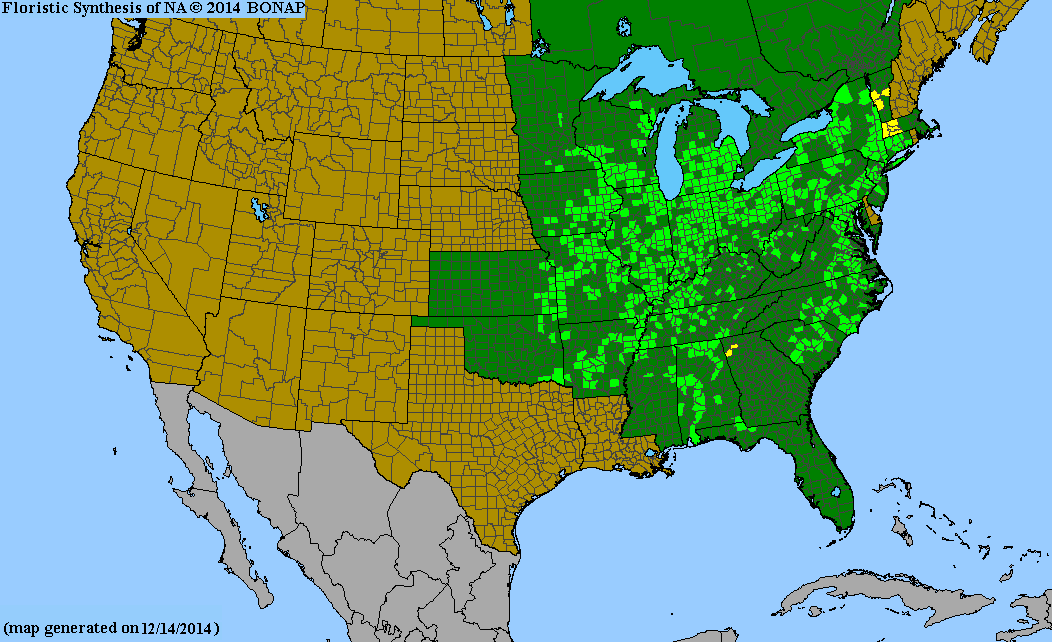
BONAP Range Map:
SE Michigan Monthly Observations:
Previously Known As:
Carex asa-grayi
Common Names:
Gray's sedge, Gray sedge, bur sedge, mace sedge, morning star sedge, club sedge
Coefficient of Conservatism (C):
6.0
— Prefers natural areas
This plant does best in natural areas but can handle some changes to its environment. Finding it suggests the habitat is in decent shape.
Explained
Coefficient of Wetness (CW):
-3.0
— Prefers wet conditions
This plant is usually found in wetlands or very moist areas, but can sometimes grow in drier spots.
Explained
Similar Species / Distinguishing Features:(ⓘ Prompt)
• Native — **Carex intumescens** (Bladder Sedge): carpellate spikes are short-ovoid rather than perfectly spherical, with 1-12 ascending to spreading perigynia (vs. 8-35 perigynia radiating equally in all directions), and perigynium base is convexly rounded rather than wedge-shaped.
• Native — **Carex lupulina** (Hop Sedge): thick cylindrical pistillate spikes with as many as 80 ascending perigynia per spike, rather than globular spikes with perigynia radiating in all directions.
• Native — **Carex lupulina** (Hop Sedge): thick cylindrical pistillate spikes with as many as 80 ascending perigynia per spike, rather than globular spikes with perigynia radiating in all directions.
• Based on genus patterns: Carex grayi may be confused with other large-fruited sedges in the Carex section Vesicariae.
• Native — Carex intumescens (bladder sedge) has similarly inflated perigynia but typically smaller overall and more pointed beaks.
• Native — Carex lupulina (hop sedge) produces large inflated fruits but perigynia are more clustered and less distinctly club-shaped.
• Native — Carex hystericina (porcupine sedge) has inflated perigynia but they are more densely packed and typically more yellow-green. Based on family patterns: Other Cyperaceae with inflated seed structures might cause confusion, but most lack the distinctive club-shaped perigynia clustering typical of C. grayi.
• Native — Carex intumescens (bladder sedge) has similarly inflated perigynia but typically smaller overall and more pointed beaks.
• Native — Carex lupulina (hop sedge) produces large inflated fruits but perigynia are more clustered and less distinctly club-shaped.
• Native — Carex hystericina (porcupine sedge) has inflated perigynia but they are more densely packed and typically more yellow-green. Based on family patterns: Other Cyperaceae with inflated seed structures might cause confusion, but most lack the distinctive club-shaped perigynia clustering typical of C. grayi.
Wikipedia Summary:
Carex grayi, commonly known as Gray's sedge, is a species of flowering plant in the Cyperaceae family.
Cloudinary Images - Identification
3 images

