Brown Fox Sedge
Carex vulpinoidea
Species Identification
Information needed to identify the plant in the field
Native-MIFlora:
Native
Duration:
perennial
Height:
2'-3'
Stature:
Knee
Bloom Color:
Green
Compact Bloom Range:
JUN - OCT
Light:
Sn, P, Sh
Moisture:
D, M, Ms, W
Michigan Flora Description:
Wet, usually open ground of all sorts, especially shores, river and stream margins, ditches, meadows and clearings, and depressions in or bordering forests. One of our most abundant species, often somewhat weedy. This is a later species to flower and fruit than the similar but much less common Carex annectens , and the culms are shorter than the leaves until late in the season, when, however, they can become as long as those of C. annectens . See notes under C. annectens . From Carex stipata , also very common and with somewhat similar inflorescences (and cross-corrugated sheaths), this can be easily separated by the hard, bluntly triangular culms, and the much smaller perigynia.
Germination Ecology / Real-World Behavior:(ⓘ Prompt)
Seeds ripen and disperse from mid to late summer, changing from green to golden yellow or brown as they mature. The perigynia (seed cases) break away individually from the flower clusters and are carried by wind or water to new locations. Seeds likely germinate the following spring after experiencing natural cold stratification over winter. This sedge is adapted to seasonal flooding and can colonize disturbed, moist sites where competition is reduced.
Based on genus patterns: Carex species typically produce seeds in late spring to early summer that disperse shortly after ripening. Based on family patterns: Sedge seeds generally have physiological dormancy requiring cold-moist stratification over winter months. Based on genus patterns: Natural germination occurs in spring following snowmelt when soil temperatures warm and moisture is abundant. Seeds that fall in summer or fall typically remain dormant through winter, with germination triggered by the combination of adequate chilling and warming temperatures in spring.
Habitat Notes:(ⓘ Prompt)
Brown fox sedge grows in wet, usually open areas throughout Michigan, including shores, stream margins, ditches, meadows, clearings, and depressions in or near forests. It's one of Michigan's most abundant sedge species and often grows in somewhat weedy conditions. The seeds are contained in small perigynia (seed cases) that form dense, clustered spikes. These perigynia have distinctive longer beaks and are dispersed when they fall from the plant, often aided by water movement in the wet habitats where this sedge thrives.
Brown fox sedge also thrives in human-disturbed habitats like roadside ditches and can be weedy in some places, favoring disturbed sites. In the Midwest, it's found in floodplain woodland openings, swamps, soggy thickets, river-bottom prairies, prairie swales, sedge meadows, and areas around ponds. It tolerates seasonal flooding and is often the dominant sedge in degraded wetlands. The perigynia mature from green to golden yellow, yellowish brown, or brown, and individual perigynia break away from their clusters for dispersal by wind or water.
Based on genus patterns: Carex vulpinoidea typically inhabits wet meadows, marshes, ditches, and poorly drained areas in full sun to partial shade. Based on species patterns: This sedge forms dense colonies in disturbed wetlands, roadside ditches, and seasonal pools where water levels fluctuate. Based on family patterns: Seeds are enclosed in perigynia (inflated sacs) that can float temporarily, allowing water dispersal during spring floods or high water periods. Based on genus patterns: The clustered seed heads break apart in late summer, releasing individual perigynia that may be carried by water, wildlife, or mechanical disturbance to new sites.
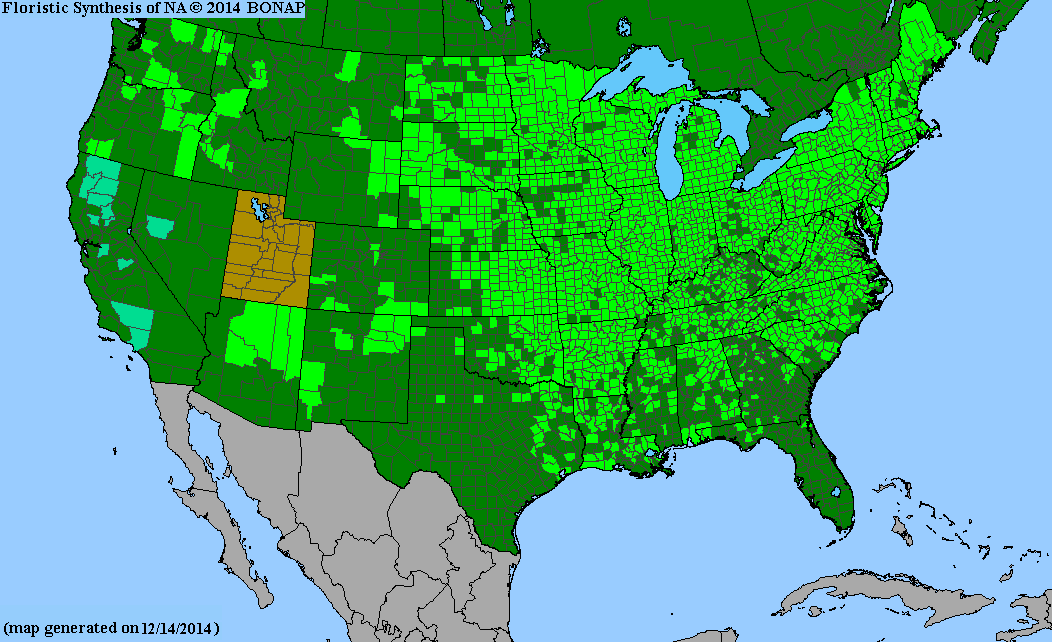
BONAP Range Map:
SE Michigan Monthly Observations:
Previously Known As:
Carex bracteosa, Carex microsperma, Carex microspherma, Carex moniezii, Carex muhlenbergii, Carex muhlenbergii, Carex multiflora, Carex multiflora, Carex polymorpha, Carex scabrior, Carex scabrior, Carex scabrior, Carex setacea, Carex vaginiformis, Carex vulpiniformis
Common Names:
fox sedge, brown fox sedge, American fox sedge
Coefficient of Conservatism (C):
1.0
— Found almost anywhere
This plant grows in all kinds of places, including roadsides and disturbed areas. It's a survivor that isn't picky about conditions.
Explained
Coefficient of Wetness (CW):
-5.0
— Loves wet feet
This plant almost always grows in wetlands. It thrives standing in water or saturated soil.
Explained
Similar Species / Distinguishing Features:(ⓘ Prompt)
• Native — Carex annectens (Yellow Fox Sedge): Both species have similar cluster-like inflorescences (flower clusters) and cross-corrugated sheaths, but C. annectens typically has fruiting stems that are taller than the leaf blades, while C. vulpinoidea has leaf blades that are similar height or taller than the fruiting stems. C. vulpinoidea also typically has spikes longer than 5.5 cm and longer beak relative to the winged body on the perigynia (small seed cases).
• Native — Carex stipata (Awl-fruited Sedge): Both are very common with somewhat similar inflorescences and cross-corrugated sheaths, but C. vulpinoidea has hard, bluntly triangular culms (stems) and much smaller perigynia compared to C. stipata.
• Native — Carex stipata (Awl-fruited Sedge): Both are very common with somewhat similar inflorescences and cross-corrugated sheaths, but C. vulpinoidea has hard, bluntly triangular culms (stems) and much smaller perigynia compared to C. stipata.
• Native — Carex brachyglossa (Yellow Fox Sedge): Both have similar bristly, fox-tail-like inflorescences, but C. brachyglossa produces a less bristly inflorescence that becomes golden-yellow at maturity and has leaves that do not overtop the culms, while C. vulpinoidea has leaves that typically overtop the flowering stems.
• Native — Carex sparganioides (Bur-Reed Sedge): Similar appearance with cluster-like inflorescences, but C. sparganioides has wider leaves and more distinct gaps between spikelets along the inflorescence compared to the overlapping spikelets of C. vulpinoidea.
• Native — Carex decomposita (Cypress Knee Sedge): Both form large tufts with narrow leaves, but C. decomposita has wider leaves and obovoid-flattened perigynia rather than the ovoid-flattened perigynia of C. vulpinoidea.
• Native — Carex sparganioides (Bur-Reed Sedge): Similar appearance with cluster-like inflorescences, but C. sparganioides has wider leaves and more distinct gaps between spikelets along the inflorescence compared to the overlapping spikelets of C. vulpinoidea.
• Native — Carex decomposita (Cypress Knee Sedge): Both form large tufts with narrow leaves, but C. decomposita has wider leaves and obovoid-flattened perigynia rather than the ovoid-flattened perigynia of C. vulpinoidea.
• Based on genus patterns: Fox sedge is commonly confused with other yellow-green, clustered sedges in wet areas.
• Native — Carex stipata (awl-fruited sedge) has similar dense, yellowish spikes but typically grows taller and has more pointed perigynia.
• Native — Carex laevivaginata (smooth-sheathed sedge) forms similar clusters but has smoother leaf sheaths and less densely packed spikes.
• Native — Carex crus-corvi (crow-foot sedge) has a more distinctly branched, crow's-foot-like inflorescence structure. Based on family patterns: Other wetland Cyperaceae like Scirpus species lack the distinctive perigynium structures that characterize all Carex species.
• Native — Carex stipata (awl-fruited sedge) has similar dense, yellowish spikes but typically grows taller and has more pointed perigynia.
• Native — Carex laevivaginata (smooth-sheathed sedge) forms similar clusters but has smoother leaf sheaths and less densely packed spikes.
• Native — Carex crus-corvi (crow-foot sedge) has a more distinctly branched, crow's-foot-like inflorescence structure. Based on family patterns: Other wetland Cyperaceae like Scirpus species lack the distinctive perigynium structures that characterize all Carex species.
Wikipedia Summary:
Carex vulpinoidea is a species of sedge known by the common name fox sedge or American fox-sedge. It is native to North America, including most of Canada, the Dominican Republic, the United States and parts of Mexico, and it is known in Europe and New Zealand as an introduced species. The sedge lives in wet and seasonally wet habitat, and grows easily as a roadside weed. It produces clumps of stems up to a meter tall....
Cloudinary Images - Identification
3 images

