Sand/Lance-leaf Coreopsis
Coreopsis lanceolata
Species Identification
Information needed to identify the plant in the field
Native-MIFlora:
Native
Duration:
perennial
Height:
1'-2'
Stature:
Knee
Bloom Color:
Yellow
Compact Bloom Range:
JUN - AUG
Light:
Sn
Moisture:
D, M
Michigan Flora Description:
Rather local (sometimes common) on sand dunes along Lake Michigan and Lake Huron and adjacent dry to moist shores and borders of forests; open sandy banks, grasslands, roadsides, oak-pine savanna; banks and bluffs. Some populations may represent escapes from cultivation; this showy native does well in gardens and spreads readily.
Germination Ecology / Real-World Behavior:(ⓘ Prompt)
Lance-leaf coreopsis seeds develop about four weeks after flowers finish blooming and are dispersed in late summer to fall. The seeds (achenes) have thin papery wings that help them disperse by wind. Seeds do not appear to have strong dormancy mechanisms and can germinate the following spring without extended cold treatment, though some seeds may remain dormant and germinate in subsequent years. Natural germination typically occurs in spring when soil warms and moisture is adequate.
Based on species patterns: Coreopsis lanceolata seeds typically disperse in late fall through winter, with the small achenes carried by wind or becoming buried in leaf litter. Based on genus patterns: Seeds exhibit physiological dormancy that is broken by cold-moist stratification during winter months, requiring 30-90 days of temperatures near freezing. Based on life-history patterns: Natural germination occurs in early spring when soil temperatures warm and day length increases, with light often enhancing germination rates. Seeds may remain viable in the soil for several years, creating a persistent seed bank that allows for germination across multiple seasons.
Habitat Notes:(ⓘ Prompt)
Sand coreopsis grows on sand dunes along Lake Michigan and Lake Huron, as well as adjacent dry to moist shores and forest borders. It thrives in open sandy banks, grasslands, roadsides, and oak-pine savannas. The plant spreads readily and does well in disturbed areas like banks and bluffs. As a member of the sunflower family, sand coreopsis produces seeds with small, dry fruits that can be dispersed by wind or transported by animals that brush against the mature flower heads.
Broadens to include mesic to dry sand prairies, gravel prairies, hill prairies, limestone glades, thinly wooded bluffs, meadows, fields, and human-disturbed habitats like railroads. Seeds are flattened with brown papery wings and lose their paired awns (bristles) early, becoming truncate at the tips. The winged seeds can be carried by wind currents or dispersed when animals brush against the dried flower heads.
Based on species patterns: Coreopsis lanceolata typically grows in open, sunny areas including prairies, old fields, roadsides, and disturbed sites with well-drained soils. Based on genus patterns: Seeds are produced in late summer to fall as small, flattened achenes that disperse primarily by wind and gravity. The seeds lack the prominent pappus of some composites but may have small scales or wings that aid in short-distance wind dispersal. Seeds can also spread through human activity along roadsides and through wildlife that may carry them in fur or feathers.
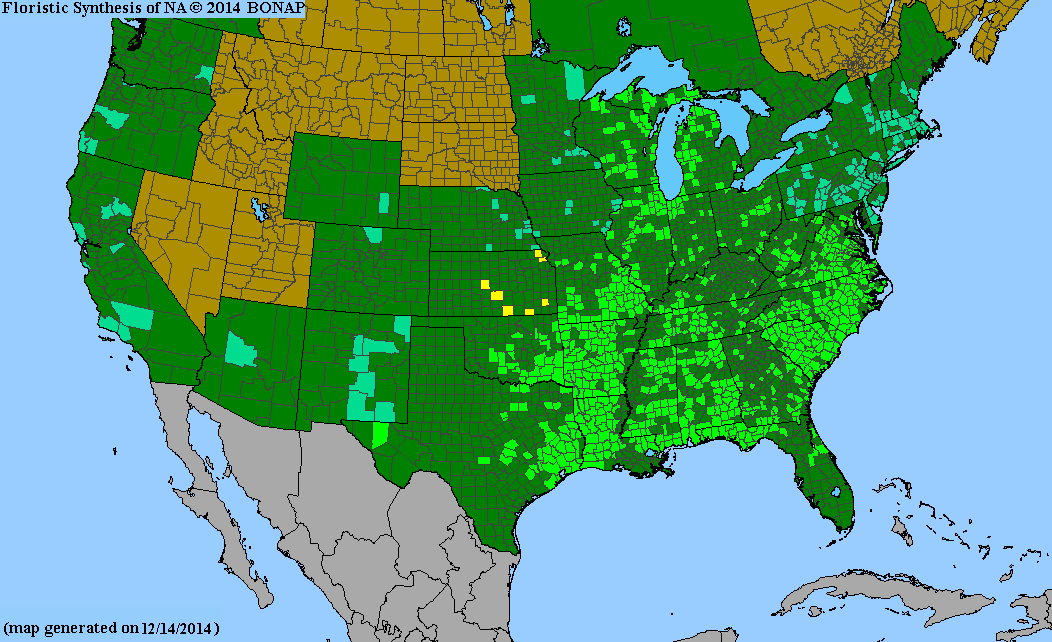
BONAP Range Map:
SE Michigan Monthly Observations:
Previously Known As:
Bidens lanceolata, Chrysomelea lanceolata, Coreopsis crassifolia, Coreopsis crassifolia, Coreopsis heterogyna, Coreopsis oblongifolia, Coreopsoides lanceolata
Common Names:
lanceleaf coreopsis, lance-leaved coreopsis, sand coreopsis, tickseed
Coefficient of Conservatism (C):
8.0
— Needs quality habitat
This plant is choosy about where it lives. It strongly prefers natural areas that haven't been heavily disturbed.
Explained
Coefficient of Wetness (CW):
3.0
— Prefers dry conditions
This plant usually grows in well-drained, drier upland areas and may struggle in wet soils.
Explained
Similar Species / Distinguishing Features:(ⓘ Prompt)
• Native — **Greater Tickseed (Coreopsis major)** has larger flower heads (1-2 inches vs 2-3 inches) and leaves deeply segmented into 3 parts appearing as a whorl of 6 leaflets, while lance-leaved coreopsis typically has unlobed or simple-lobed leaves.
• Native — **Other perennial yellow Coreopsis species** (nearly a dozen occur in eastern regions) may share similar yellow daisy-like flowers but differ in leaf shape, size, and lobing patterns - lance-leaved coreopsis is distinguished by its lance-shaped leaves that are often unlobed and concentrated on the lower half of stems.
• Horticultural — **Cultivars and double-flowered varieties** of lance-leaved coreopsis itself have been developed for gardens, including bicolored forms, but maintain the same basic leaf and growth characteristics. Note: Lance-leaved coreopsis can vary significantly in hairiness between populations, from completely smooth (var. lanceolata) to conspicuously hairy (var. villosa), which may cause confusion when comparing specimens.
• Native — **Other perennial yellow Coreopsis species** (nearly a dozen occur in eastern regions) may share similar yellow daisy-like flowers but differ in leaf shape, size, and lobing patterns - lance-leaved coreopsis is distinguished by its lance-shaped leaves that are often unlobed and concentrated on the lower half of stems.
• Horticultural — **Cultivars and double-flowered varieties** of lance-leaved coreopsis itself have been developed for gardens, including bicolored forms, but maintain the same basic leaf and growth characteristics. Note: Lance-leaved coreopsis can vary significantly in hairiness between populations, from completely smooth (var. lanceolata) to conspicuously hairy (var. villosa), which may cause confusion when comparing specimens.
• Based on genus patterns:
• Native — Coreopsis tripteris (tall coreopsis) has three-lobed leaves and grows much taller (4-8 feet) versus the simple, lance-shaped leaves and shorter stature of C. lanceolata.
• Native — Coreopsis grandiflora has broader, more oval petals and often larger flower heads.
• Native — Coreopsis verticillata (threadleaf coreopsis) has very narrow, thread-like divided leaves rather than broad lance-shaped ones. Based on family patterns:
• Native — Rudbeckia species (black-eyed susans) have similar yellow daisy flowers but typically show dark centers and lack the notched petal tips common in Coreopsis.
• Horticultural — Garden-bred Coreopsis cultivars may show double flowers, unusual colors, or modified leaf shapes not found in wild populations.
• Native — Coreopsis tripteris (tall coreopsis) has three-lobed leaves and grows much taller (4-8 feet) versus the simple, lance-shaped leaves and shorter stature of C. lanceolata.
• Native — Coreopsis grandiflora has broader, more oval petals and often larger flower heads.
• Native — Coreopsis verticillata (threadleaf coreopsis) has very narrow, thread-like divided leaves rather than broad lance-shaped ones. Based on family patterns:
• Native — Rudbeckia species (black-eyed susans) have similar yellow daisy flowers but typically show dark centers and lack the notched petal tips common in Coreopsis.
• Horticultural — Garden-bred Coreopsis cultivars may show double flowers, unusual colors, or modified leaf shapes not found in wild populations.
Wikipedia Summary:
Coreopsis lanceolata, the Lance-leaved coreopsis, is a North American species of Tickseed in the sunflower family. It is apparently native to the eastern and central parts of the United States and naturalized in Canada, the western United States, Mesoamerica, South America, South Africa, and eastern Asia.