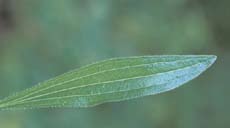
Pale Purple Coneflower
Echinacea pallida
Species Identification
Information needed to identify the plant in the field
Native-MIFlora:
Non-native
Duration:
perennial
Height:
2'-3'
Stature:
Knee
Bloom Color:
Lt. Lavender
Compact Bloom Range:
JUN - JUL
Light:
Sn, P
Moisture:
D, M
Michigan Flora Description:
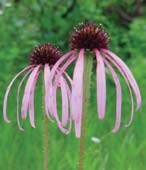
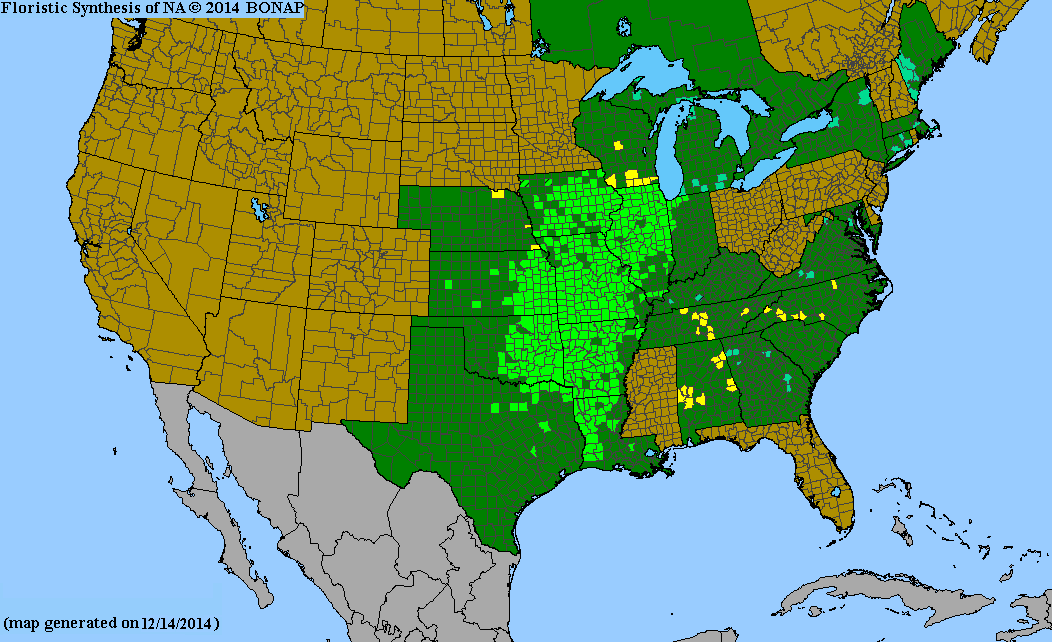
Chiefly in disturbed sites: along railroads (and adjacent prairie), fields, rocky clearings, edge of a gravel pit (Beaver Island); native south and west of Michigan and first collected in 1886 in Keweenaw Co. Our southwestern Michigan collections are from along railroad tracks and it is doubtful whether even they represent native stands. One of the best known populations in the state is in a clearing along the highway at the site of the old lumbering town of Kenneth, northwest of Moran in Mackinac Co., where thousands of plants blooming in July make a spectacular sight. The rays in this species are paler than in E. purpurea , and at maturity are decidedly drooping.
Germination Ecology / Real-World Behavior:(ⓘ Prompt)
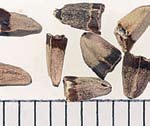
Pale purple coneflower seeds disperse in fall and early winter when the cone-shaped seed heads mature and turn dark brown to black. The seeds (achenes) have no fluffy pappus and rely on wind, gravity, and animals for dispersal from the prominent seed heads. Seeds require cold, moist stratification over winter to break dormancy - they need several months of cold temperatures combined with moisture to trigger germination the following spring. Without this cold treatment, germination rates are poor. In nature, seeds germinate in spring after experiencing winter's cold stratification, typically taking 2-3 years to reach flowering maturity.
Based on genus patterns: Seeds disperse in late fall through winter, requiring cold-moist stratification to break physiological dormancy. Based on species patterns: Natural germination occurs in spring after experiencing 60-90 days of cold temperatures below 40°F with consistent moisture. Seeds exhibit double dormancy requiring both cold stratification and light for germination, with germination rates typically improving significantly after stratification. Based on general practice: In natural settings, germination is often sporadic and may occur over multiple seasons, with best germination occurring in the second spring following seed dispersal.
Habitat Notes:(ⓘ Prompt)
Pale purple coneflower grows in dry to mesic prairies, oak savannas, limestone glades, and rocky clearings. In Illinois, it's found in black soil prairies, openings in dry rocky woods, abandoned fields, and areas along railroads. Seeds develop without fluffy dispersal structures (pappus), so they typically fall near the parent plant or are carried short distances by wind and gravity.
Based on species patterns: Echinacea pallida typically occurs in dry to mesic prairies, open woodlands, and limestone glades across the Great Lakes region. Based on genus patterns: Plants prefer well-drained soils and full sun to partial shade, often found in areas with periodic disturbance. Based on family patterns: Seeds are dispersed by wind through small, chaffy structures (pappus) attached to each seed, though the pappus in Echinacea is relatively small compared to other Asteraceae. Based on species patterns: Seeds may also disperse locally through gravity when the dried seed heads break apart, with birds occasionally feeding on the seeds and providing longer-distance dispersal.
BONAP Range Map:
SE Michigan Monthly Observations:
Previously Known As:
Brauneria pallida, Rudbeckia pallida
Common Names:
Pale Purple Coneflower, Pale Coneflower, Pale Echinacea
Coefficient of Wetness (CW):
5.0
— Needs dry ground
This plant almost never grows in wetlands. It needs well-drained soil and can rot in soggy conditions.
Explained
Similar Species / Distinguishing Features:(ⓘ Prompt)
• Native — Purple Coneflower (E. purpurea) has darker purple rays (petals) that are less drooping at maturity, and seeds that are solid gray rather than gray with a brown stripe like candy corn.
• Native — Narrow-leaved Purple Coneflower (E. angustifolia) has shorter, broader ray petals and slightly smaller overall size compared to E. pallida's long, narrow drooping rays.
• Native — Bush's Coneflower (E. paradoxa) has similar flower structure but deep yellow petals instead of pale purple to pink.
• Native — Bush's Coneflower (E. paradoxa) has similar flower structure but deep yellow petals instead of pale purple to pink.
• Based on genus patterns:
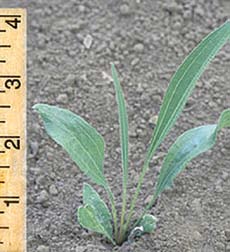
• Native — Echinacea purpurea has broader leaves and typically more drooping petals, while E. pallida has narrower, more lance-shaped leaves and less reflexed petals.
• Native — Echinacea angustifolia is very similar but typically has hairier stems and leaves, and E. pallida generally grows taller with a more branched appearance. Based on family patterns:
• Native — Rudbeckia species (black-eyed susans) have yellow petals and dark centers, unlike the pale purple petals of E. pallida.
• Native — Ratibida pinnata has deeply divided leaves and yellow petals with prominent dark cones.
• Horticultural — Cultivated Echinacea varieties may show color variations or doubled flowers not seen in wild E. pallida.
• Native — Echinacea purpurea has broader leaves and typically more drooping petals, while E. pallida has narrower, more lance-shaped leaves and less reflexed petals.
• Native — Echinacea angustifolia is very similar but typically has hairier stems and leaves, and E. pallida generally grows taller with a more branched appearance. Based on family patterns:
• Native — Rudbeckia species (black-eyed susans) have yellow petals and dark centers, unlike the pale purple petals of E. pallida.
• Native — Ratibida pinnata has deeply divided leaves and yellow petals with prominent dark cones.
• Horticultural — Cultivated Echinacea varieties may show color variations or doubled flowers not seen in wild E. pallida.
Wikipedia Summary:
Echinacea pallida, commonly called pale purple coneflower, is a species of herbaceous perennial plant in the family Asteraceae. It is sometimes grown in gardens and used for medicinal purposes. Its native range is the central region of the United States, in the Mississippi Valley, the southeastern Great Plains, and the region south of Lake Michigan. Most of the known populations are in the region from southern Wisconsin and Iowa south to Louisiana and eastern Texas, with...
Cloudinary Images - Identification
8 images