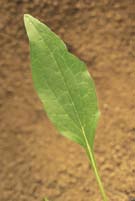
Purple Coneflower
Echinacea purpurea
Species Identification
Information needed to identify the plant in the field
Native-MIFlora:
Non-native
Duration:
perennial
Height:
3'-3.5'
Stature:
Chest
Bloom Color:
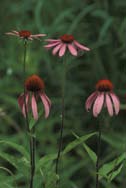
Pink-Purple
Compact Bloom Range:
JUL - AUG
Light:
Sn, P
Moisture:
D, M, Ms
Michigan Flora Description:
Collected by the First Survey in 1838 at Gull Prairie, Kalamazoo Co., and also in St. Joseph Co. (no stated locality, but probably near Centreville). These seem very likely to have been native occurrences for this species. Not collected in the State again until 1868, with no habitat or indication of status, but the locality, Ann Arbor, is suggestive that it was not native (if not simply a cultivated plant). An 1888 collection from a "field" at Trenton, Wayne Co. is also suspect. An 1891 collection at Grand Rapids, Kent Co., reported by Cole (1901) as "collected in a field near Butterworth Ave." again is not from a native setting. This is a showy plant, very popular in horticulture and more recently in prairie restorations despite its extremely limited former occurrence as a native plant. All recent records are from along roadsides and fields and represent escapes from gardens or, more recently, from prairie plantings.
Germination Ecology / Real-World Behavior:(ⓘ Prompt)
Purple coneflower seeds naturally disperse in fall and winter from mature seedheads. The seeds require cold-moist stratification over winter to break dormancy - two months of cold, moist conditions are needed for optimal germination. Without this cold treatment, germination rates are poor. Seeds naturally germinate in spring after winter conditioning, typically emerging when soil temperatures warm and moisture is adequate. Some sources indicate no pre-treatment is necessary for basic germination, but stratification significantly improves germination success rates.
Based on species patterns: Echinacea purpurea seeds disperse in late fall through winter as the seed heads dry and break apart. Seeds exhibit physiological dormancy requiring cold stratification to break internal chemical inhibitors. Based on general practice: Natural germination typically occurs in spring after 60-120 days of cold-moist conditions during winter. Seeds may remain dormant in soil for multiple seasons if stratification requirements aren't fully met. Germination is often triggered by warming soil temperatures and increasing day length in spring.
Habitat Notes:(ⓘ Prompt)
Purple coneflower was historically native to Michigan prairies but is now extremely rare in natural settings. In Southeast Michigan, it's most commonly found along roadsides and in fields as an escape from gardens or prairie restoration plantings. The seeds are dispersed when the cone-shaped seed head (what remains after the colorful petals drop) releases individual seeds. Each seed develops from the flowers that made up the central cone, and the mature seeds fall from this spiky, dome-shaped structure.
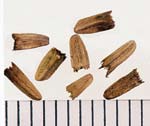
These broader sources confirm purple coneflower's natural habitat in moist to mesic prairies, woodland edges, and savannas across the eastern United States. The species naturally occurs in well-drained soils in open woodlands, thickets, and limestone glades from Georgia to Iowa. Seeds lack the fluffy tufts (pappus) found on many other aster family plants - instead they have only a small toothed crown and are described as narrow, flat, and dark-colored when mature.
Based on species patterns: Purple coneflower naturally occurs in prairies, savanna openings, and woodland edges across much of eastern North America, including Michigan. Based on general practice: It tolerates a wide range of soil conditions from dry to moderately moist and thrives in full sun to partial shade, making it adaptable to disturbed sites and restoration plantings. Based on species patterns: Seeds are dispersed primarily by gravity and wildlife, as the dried seed heads (achenes) are eaten by finches, chickadees, and other small birds throughout fall and winter. The cone-shaped receptacle holds seeds firmly until they're individually plucked by birds or eventually fall near the parent plant, creating natural colonies over time.
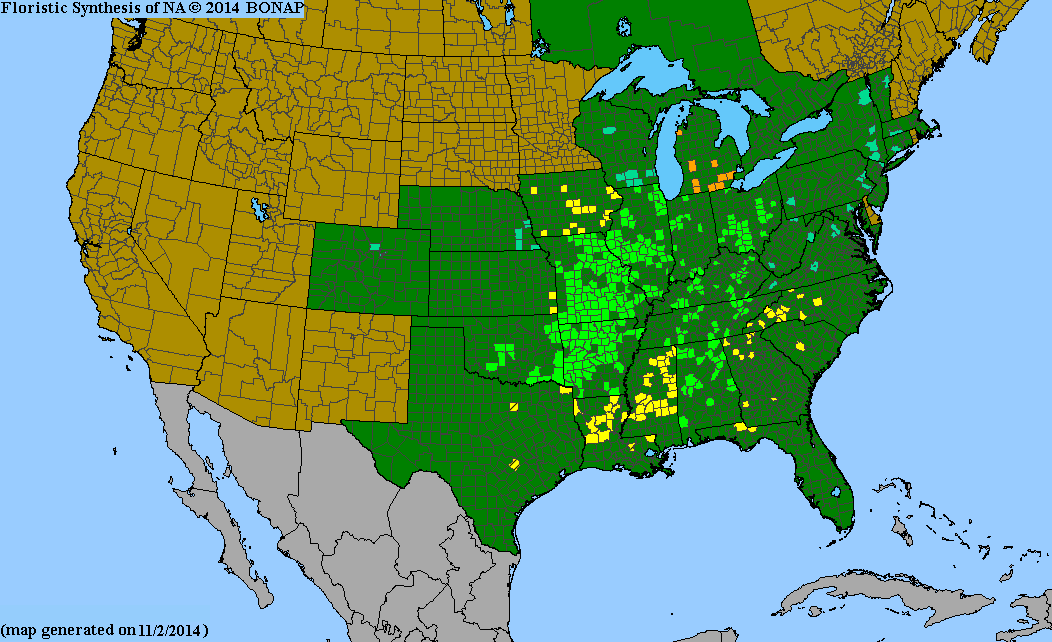
BONAP Range Map:
SE Michigan Monthly Observations:
Previously Known As:
Brauneria purpurea, Echinacea intermedia, Echinacea intermedia, Echinacea serotina, Echinacea serotina, Echinacea serotina, Helichroa alba, Helichroa amoena, Helichroa crocea, Helichroa elatior, Helichroa fusca, Helichroa fuscata, Helichroa linnaeana, Helichroa purpurea
Common Names:
Purple Coneflower, Eastern Purple Coneflower, Purple Echinacea, Echinacea
Coefficient of Wetness (CW):
5.0
— Needs dry ground
This plant almost never grows in wetlands. It needs well-drained soil and can rot in soggy conditions.
Explained
Similar Species / Distinguishing Features:(ⓘ Prompt)
• Native — Echinacea pallida (pale purple coneflower) has narrower leaves, an earlier and shorter blooming period, and seeds with distinctive stripes, while E. purpurea has broader leaves, blooms slightly later and longer, and has stripe-less seeds.
• Native — Echinacea angustifolia (narrow-leaved purple coneflower) has mostly basal leaves that are long and narrow, while E. purpurea has broader leaves that are alternate along the stem.
• Horticultural — White-flowered cultivars of E. purpurea ('White Swan') are common in gardens but very rare in wild populations.
• Horticultural — White-flowered cultivars of E. purpurea ('White Swan') are common in gardens but very rare in wild populations.
• Based on genus patterns: Other Echinacea species are the most likely confusion, particularly E. pallida (pale purple coneflower) which has narrower, more drooping petals and E. angustifolia (narrow-leaved coneflower) which has smaller flowers and narrower leaves.
• Native — Rudbeckia species (black-eyed susans) share the prominent central cone but typically have yellow petals and darker cone centers.
• Native — Ratibida pinnata (gray-headed coneflower) has yellow petals that droop more dramatically and a more elongated gray-brown cone.
• Horticultural — Many cultivated Echinacea hybrids and color variants exist in gardens, including white, orange, and multi-colored forms that may obscure identification. Based on family patterns: Other Asteraceae with prominent disk flowers like Monarda (wild bergamot) can appear similar when not in full bloom, but Monarda has square stems and different leaf arrangement.
• Native — Rudbeckia species (black-eyed susans) share the prominent central cone but typically have yellow petals and darker cone centers.
• Native — Ratibida pinnata (gray-headed coneflower) has yellow petals that droop more dramatically and a more elongated gray-brown cone.
• Horticultural — Many cultivated Echinacea hybrids and color variants exist in gardens, including white, orange, and multi-colored forms that may obscure identification. Based on family patterns: Other Asteraceae with prominent disk flowers like Monarda (wild bergamot) can appear similar when not in full bloom, but Monarda has square stems and different leaf arrangement.
Wikipedia Summary:
Echinacea purpurea (eastern purple coneflower, hedgehog coneflower, or purple coneflower) is a North American species of flowering plant in the sunflower family. It is native to eastern North America and present to some extent in the wild in much of the eastern, southeastern and midwestern United States as well as in the Canadian Province of Ontario. It is most common in the Ozarks and in the Mississippi/Ohio Valley.
Cloudinary Images - Identification
8 images