Big Leaf/Large-Leaved Aster
Eurybia macrophylla
Species Identification
Information needed to identify the plant in the field
Native-MIFlora:
Native
Duration:
perennial
Height:
1'-3'
Stature:
Knee
Bloom Color:
Lavender
Compact Bloom Range:
JUL - AUG
Light:
P, Sh
Moisture:
D, M
Michigan Flora Description:
Aster macrophyllus of Michigan Flora . In forests of all kinds: beech-maple, hemlock-northern hardwoods, drier sites (with oak, hickory, aspen, jack pine, or mixed conifer-hardwoods), less often in swamps and river banks; common on forested dunes, also in northern rocky forests with spruce and fir. Often abundant after disturbance such as road construction, logging, or fire; spreading to roadsides, railroad embankments, pine plantations. Eurybia macrophylla is widespread and very variable in size, pubescence, and glandularity. Very rarely a specimen is only sparsely glandular, but even in these individuals, glands can be found along the midveins of the inflorescence bracts. These sparsely gladualr individuals can be distinguished easily from E. furcata by the strongly cordate bases of the lower (or even middle) leaf blades, and the middle and upper leaves much reduced in size. In E. furcata , the base is at most truncate and the leaves are well developed at the upper and middle nodes. Such sparsely gladular individuals of E. macrophylla are more difficut to distinguish from E. schreberi. In E. schreberi glands appear to be most consistently absent from the undersides of the inflorescence bracts and the rays are apparently consistently white. White-rayed plants of E. macropyhylla do rarely occur, but The rays are usually pinkish to blue, though fading to near white with age. Vegetative shoots with large heart-shaped leaves are generally abundant in forests, and noticeable because of their large size. In comparison, flowering stems are rather sparse in most years, and favor borders, trails, and openings.
Germination Ecology / Real-World Behavior:(ⓘ Prompt)
Big-leaved aster disperses seeds in autumn via wind-carried achenes (small dry seeds) with tufts of tawny to orange-brown bristly hairs. Seeds require cold stratification - extended exposure to cold, moist conditions over winter - to break dormancy and trigger spring germination. This dormancy mechanism prevents seeds from germinating in fall when seedlings would face harsh winter conditions. In nature, seeds scattered in late fall undergo natural cold stratification beneath snow cover and germinate the following spring after soil warms.
Based on genus patterns: Seeds disperse in late fall through early winter via wind-carried pappus, typically after achenes have dried on the plant. Based on family patterns: Seeds exhibit physiological dormancy common in Asteraceae, requiring cold-moist stratification to break internal chemical inhibitors. Based on general practice: Natural germination occurs in spring after winter's cold period satisfies dormancy requirements, with seedlings emerging as soil temperatures warm and daylight increases. Seeds that disperse in fall remain dormant through winter, with germination triggered by the combination of adequate chilling and warming spring conditions.
Habitat Notes:(ⓘ Prompt)
Big-leaf aster thrives in forests of all kinds throughout Michigan, from beech-maple and hemlock-northern hardwoods to drier sites with oak, hickory, aspen, jack pine, or mixed woods, and is common on forested dunes. It prefers well-drained soils in canopy openings and spreads by underground stems (rhizomes), often forming carpets of large heart-shaped leaves. The plant becomes abundant after disturbance such as road construction, logging, or fire, spreading to roadsides and railroad embankments. Seeds have fluffy attachments (pappus) that allow wind to efficiently carry them over long distances for dispersal. Flowering stems are relatively sparse compared to the abundant vegetative shoots, favoring forest borders, trails, and openings where more light is available.
Based on genus patterns: Eurybia macrophylla typically inhabits rich deciduous and mixed forests with partial to full shade, often in areas with well-drained but moisture-retentive soils. Based on family patterns: Seeds are equipped with white pappus (fluffy bristles) that enable wind dispersal, with mature seed heads opening in late fall to early winter. The pappus acts like a parachute, allowing seeds to drift on air currents away from the parent plant. Based on life-history patterns: As a woodland species, seeds may not travel as far as prairie asters due to reduced wind exposure under forest canopy, often settling within nearby forest openings or edges.
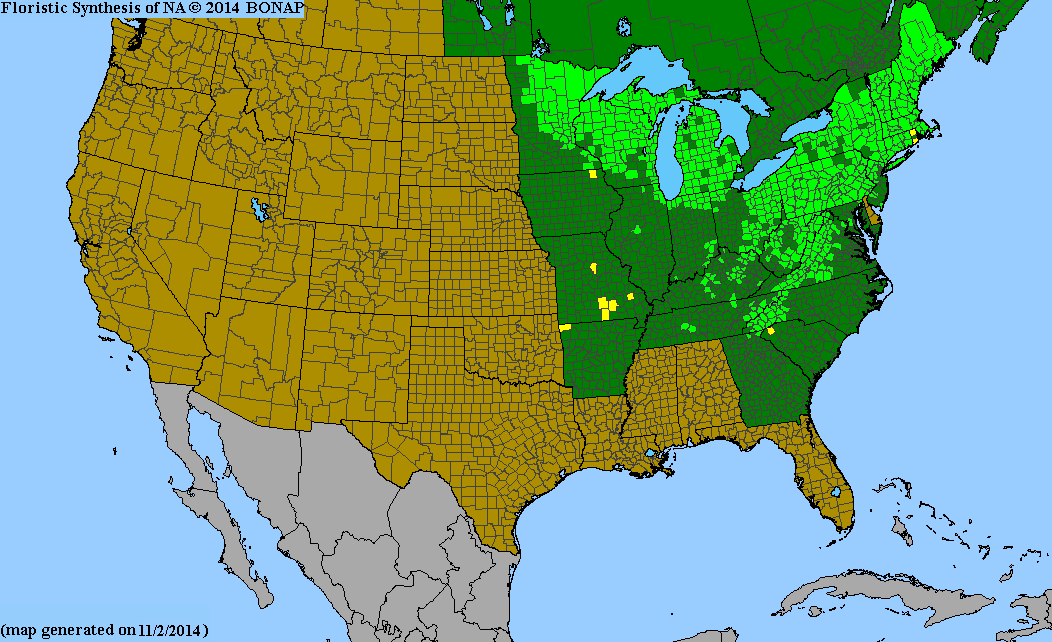
BONAP Range Map:
SE Michigan Monthly Observations:
Previously Known As:
Aster ambiguus, Aster excelsior, Aster ianthinus, Aster jussiei, Aster latifolius, Aster macrophyllus, Aster multiformis
Common Names:
bigleaf aster, large-leaved aster, bigleaf wood aster, large-leaved wood aster
Coefficient of Conservatism (C):
4.0
— Prefers natural areas
This plant does best in natural areas but can handle some changes to its environment. Finding it suggests the habitat is in decent shape.
Explained
Coefficient of Wetness (CW):
5.0
— Needs dry ground
This plant almost never grows in wetlands. It needs well-drained soil and can rot in soggy conditions.
Explained
Similar Species / Distinguishing Features:(ⓘ Prompt)
• Native — Eurybia schreberi (aromatic aster): glands are consistently absent from the undersides of the flower cluster bracts, and the ray petals are apparently consistently white, whereas big-leaf aster usually has pinkish to blue rays that may fade to near white with age.
• Native — Eurybia furcata (forked aster): leaf bases are at most flat (truncate) rather than strongly heart-shaped, and the middle and upper stem leaves are well developed rather than much reduced in size compared to the large basal leaves.
• Native — Eurybia furcata (forked aster): leaf bases are at most flat (truncate) rather than strongly heart-shaped, and the middle and upper stem leaves are well developed rather than much reduced in size compared to the large basal leaves.
• Native — Eurybia divaricata (white wood aster): has fewer ray flowers (about 5-10) compared to big-leaf aster's 9-20 rays, its flower stalks usually have non-glandular hairs rather than glandular hairs, and its basal leaves are smaller in size. However, both species share flat-topped flower clusters and similar leaf shapes.
• Based on genus patterns: Other Eurybia species like E. divaricata (white oldfield aster) have smaller, narrower leaves and different bloom timing. Based on family patterns: Symphyotrichum species (fall-blooming asters) typically have smaller flowers and different leaf arrangements.
• Native — Symphyotrichum cordifolium (heart-leaved aster) has similar heart-shaped leaves but blooms later in fall with smaller, more numerous flower heads.
• Native — Eurybia divaricata (white oldfield aster) has much smaller, ovate leaves and a more open branching pattern.
• Native — Large-leaved Symphyotrichum species have similar leaf size but typically alternate rather than basal arrangement patterns. Based on general practice: Distinguishing features include the large basal leaves, early-to-mid summer bloom time, and distinctive broad heart-shaped leaf bases that are characteristic of this species within the genus.
• Native — Symphyotrichum cordifolium (heart-leaved aster) has similar heart-shaped leaves but blooms later in fall with smaller, more numerous flower heads.
• Native — Eurybia divaricata (white oldfield aster) has much smaller, ovate leaves and a more open branching pattern.
• Native — Large-leaved Symphyotrichum species have similar leaf size but typically alternate rather than basal arrangement patterns. Based on general practice: Distinguishing features include the large basal leaves, early-to-mid summer bloom time, and distinctive broad heart-shaped leaf bases that are characteristic of this species within the genus.
Wikipedia Summary:
Eurybia macrophylla, commonly known as the bigleaf aster, large-leaved aster, largeleaf aster or bigleaf wood aster, is an herbaceous perennial in the composite family that was formerly treated in the genus Aster. It is native to eastern North America, with a range extending from eastern and central Canada (from Nova Scotia to Manitoba) through the northeastern deciduous and mixed forests of New England and the Great Lakes region and south along the Appalachians as far as...
Cloudinary Images - Identification
3 images

