Bottle Gentian
Gentiana andrewsii
Species Identification
Information needed to identify the plant in the field
Native-MIFlora:
Native
Duration:
perennial
Height:
1'-2'
Stature:
Knee
Bloom Color:
Blue
Compact Bloom Range:
AUG - SEP
Light:
Sn, P
Moisture:
Ms, W
Michigan Flora Description:
Marshy or at least moist ground: meadows and wet prairies; shores, thickets, and ditches; river banks, floodplains, swamps. Our commonest species of closed or bottle gentian. Each corolla lobe terminates in a small tooth or mucro. White-flowered individuals [f. albiflora Britton] occur occasionally with the normal blue ones, and pale blue flowers also occur uncommonly. White- or blue-flowered plants may be easily distinguished from G. saponaria, which also has ciliate calyx lobes, by the broader leaves of G. andrewsii (as broad as in G. alba ) as well as the very short tips of the corolla lobes. Hybrids with G. alba [ G. × pallidocyanea J. S. Pringle] have been identified by Pringle from Genesee and Wayne Cos. The hybrid with G. puberulenta [ G. × billingtonii Farw.] was originally described from Squirrel Island on the Ontario side of the St. Clair River, and may turn up in Michigan, as might the rare hybrid with G. rubricaulis [ G. × grandilacustris J. S. Pringle], described from Minnesota.
Germination Ecology / Real-World Behavior:(ⓘ Prompt)
Seeds ripen in fall (October-November) and are dispersed by wind through papery wings. The species requires cold/moist stratification - seeds need 3 months of cold, damp conditions at around 40°F to break dormancy. Natural germination occurs after seeds overwinter in soil, typically emerging in spring after experiencing winter's cold and moisture. Seeds also require light exposure to germinate and should not be buried when planted.
Based on genus patterns: Gentiana species typically produce very small seeds that require complex dormancy-breaking mechanisms involving both cold stratification and specific light conditions. Based on family patterns: Seeds are dispersed in late fall when capsules split open, often requiring 60-120 days of cold-moist conditions to break physiological dormancy. Based on species patterns: Bottle gentian seeds specifically benefit from winter stratification followed by warm, moist conditions and may require light for final germination triggers. Natural germination occurs in early spring after snow melt when soil temperatures begin warming but moisture remains high.
Habitat Notes:(ⓘ Prompt)
Closed gentian grows in marshy or moist ground including wet meadows, wet prairies, shores, thickets, ditches, river banks, floodplains, and swamps in Michigan. It is slightly more likely to be found in wetter habitats compared to some related species. The seeds are dispersed when the papery capsules (shaped like plump duck bills) split open like beaks to release tiny seeds that are described as looking like "fried eggs." The capsules turn from the original bright blue flowers to plum purple, then to paper bag brown as they mature and open to scatter the small seeds.
Closed gentian is also found in moist black soil prairies, openings in floodplain forests, fens, swampy areas near bodies of water, and anthropogenic (human-disturbed) habitats such as meadows and fields. It often occurs in calcareous soil. The small seeds can be transported by water or wind some distance from the mother plant, with each seed wrapped in papery wings to facilitate wind dispersal.
Based on species patterns: Bottle gentian grows in moist to wet prairies, sedge meadows, and calcareous wetlands throughout the Great Lakes region. Based on genus patterns: Seeds are small and numerous, contained within capsules that split open when mature. Based on life-history patterns: As a wetland-associated perennial, it typically requires consistent moisture and can tolerate seasonal flooding. Based on species patterns: The closed flower structure requires bumblebees strong enough to force entry for pollination, making seed production dependent on robust pollinator populations. Seeds disperse locally through gravity and water movement during wet periods.
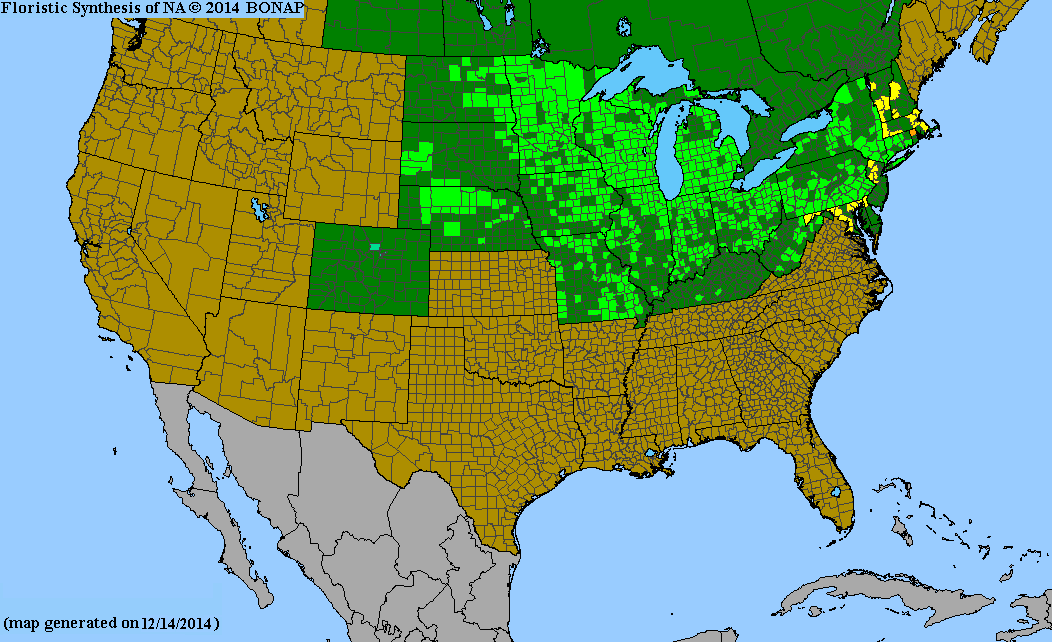
BONAP Range Map:
SE Michigan Monthly Observations:
Previously Known As:
Cuttera catesbei, Dasystephana andrewsii, Gentiana catesbaei, Gentiana saponaria, Pneumonanthe andrewsii
Common Names:
Bottle Gentian, Closed Gentian, Blind Gentian, Barrel Gentian, Cloistered Heart
Coefficient of Conservatism (C):
5.0
— Prefers natural areas
This plant does best in natural areas but can handle some changes to its environment. Finding it suggests the habitat is in decent shape.
Explained
Coefficient of Wetness (CW):
-3.0
— Prefers wet conditions
This plant is usually found in wetlands or very moist areas, but can sometimes grow in drier spots.
Explained
Similar Species / Distinguishing Features:(ⓘ Prompt)
• Native — Gentiana alba (white gentian): Distinguished by leaves that are narrower than those of closed gentian, and seed capsules (beaks) that have larger, chunkier teeth at the top of the papery shell rather than the small ragged serrations found on closed gentian. The two species can grow together and are difficult to tell apart at harvest time when flowers are not present.
• Native — Gentiana saponaria (soapwort gentian): Has similar ciliate calyx lobes (fringed sepals) but can be distinguished by narrower leaves and longer tips on the corolla lobes compared to closed gentian's broader leaves and very short corolla lobe tips.
• Native — Gentiana saponaria (soapwort gentian): Has similar ciliate calyx lobes (fringed sepals) but can be distinguished by narrower leaves and longer tips on the corolla lobes compared to closed gentian's broader leaves and very short corolla lobe tips.
• Native — Gentiana clausa (meadow bottle gentian): Often mistaken for closed gentian and much more common in New England. They differ in details of the apex of the corolla lobes, with meadow bottle gentian having bands that are not longer than the petals, while closed gentian has an interconnecting fringe that is taller than the lobes.
• Native — Gentiana linearis (narrow-leaved gentian): Occurs chiefly in the north and mountains, has very narrow leaves and open flowers rather than the closed bottle-shaped flowers of closed gentian.
• Native — Gentiana flavida (yellow/cream gentian): Has white flowers that may be confused with white-flowered forms of bottle gentian, but distinguished by more clasping leaves and flowers that do open some at the top, typically with greenish venation on the petals.
• Native — Gentianella quinquefolia (stiff gentian): An annual with light blue or lilac open flowers that have bristle-pointed, fringeless lobes and a 4-sided stem, unlike the perennial closed gentian with its closed bottle-shaped flowers and round stem.
• Native — Gentiana linearis (narrow-leaved gentian): Occurs chiefly in the north and mountains, has very narrow leaves and open flowers rather than the closed bottle-shaped flowers of closed gentian.
• Native — Gentiana flavida (yellow/cream gentian): Has white flowers that may be confused with white-flowered forms of bottle gentian, but distinguished by more clasping leaves and flowers that do open some at the top, typically with greenish venation on the petals.
• Native — Gentianella quinquefolia (stiff gentian): An annual with light blue or lilac open flowers that have bristle-pointed, fringeless lobes and a 4-sided stem, unlike the perennial closed gentian with its closed bottle-shaped flowers and round stem.
• Based on genus patterns:
• Native — Gentiana puberulenta (downy gentian) blooms earlier in late summer with shorter flowers and pubescent leaves.
• Native — Gentiana alba (plain gentian) has white or pale yellow flowers that may open slightly, compared to the deep blue closed flowers.
• Native — Gentiana saponaria (soapwort gentian) has similar closed blue flowers but typically grows in more southern regions and may have limited Michigan presence. Based on family patterns:
• Native — Gentianopsis crinita (fringed gentian) opens fully with distinctive fringed petals, blooms later in fall, and is annual rather than perennial.
• Native — Gentiana puberulenta (downy gentian) blooms earlier in late summer with shorter flowers and pubescent leaves.
• Native — Gentiana alba (plain gentian) has white or pale yellow flowers that may open slightly, compared to the deep blue closed flowers.
• Native — Gentiana saponaria (soapwort gentian) has similar closed blue flowers but typically grows in more southern regions and may have limited Michigan presence. Based on family patterns:
• Native — Gentianopsis crinita (fringed gentian) opens fully with distinctive fringed petals, blooms later in fall, and is annual rather than perennial.
Wikipedia Summary:
Gentiana andrewsii, the bottle gentian, closed gentian, or closed bottle gentian, is an herbaceous species of flowering plant in the gentian family Gentianaceae. Gentiana andrewsii is native to northeastern North America, from the Dakotas to the East Coast and through eastern Canada.
Cloudinary Images - Identification
3 images

