Wild Geranium
Geranium maculatum
Species Identification
Information needed to identify the plant in the field
Native-MIFlora:
Native
Duration:
perennial
Height:
1'-2'
Stature:
Ankle
Bloom Color:
Lt. Blue-Lavender
Compact Bloom Range:
MAY - JUN
Light:
Sn, P, Sh
Moisture:
D, M, Ms
Michigan Flora Description:
Usually in rich deciduous forests, especially in moist sites such as streamsides, pond borders, wet hollows, and swamps; less often in upland oak-hickory forests. Records from Delta Co.in the Upper Peninsula are from disturbed habitats along a railway, and the Houghton Co. record was at a brushy woods edge in a Forestry Camp; these may be accidental introductions, although other Upper Peninsula records appear to be native. A beautiful as well as common wildflower of deciduous forests throughout much of the Lower Peninsula and, sparingly, the western Upper Peninsula. Often cultivated, but there seem to be few records of this as an escape from cultivation beyond its native range. Flowers vary in color from deep pink to very pale pink, but plants with pure white flowers are quite rare [f. albiflorum (Raf.) House]. A white-flowered form of a Eurasian species, Geranium pratense L., was collected along a driveway in Ann Arbor, Washtenaw Co., in 1954, but its status, whether truly escaped or not, is doubtful. It resembles G. maculatum , but the pedicels (and outer sepals) bear dense gland-tipped hairs. Geranium pratense is known as an escape in southern Ontario.
Germination Ecology / Real-World Behavior:(ⓘ Prompt)
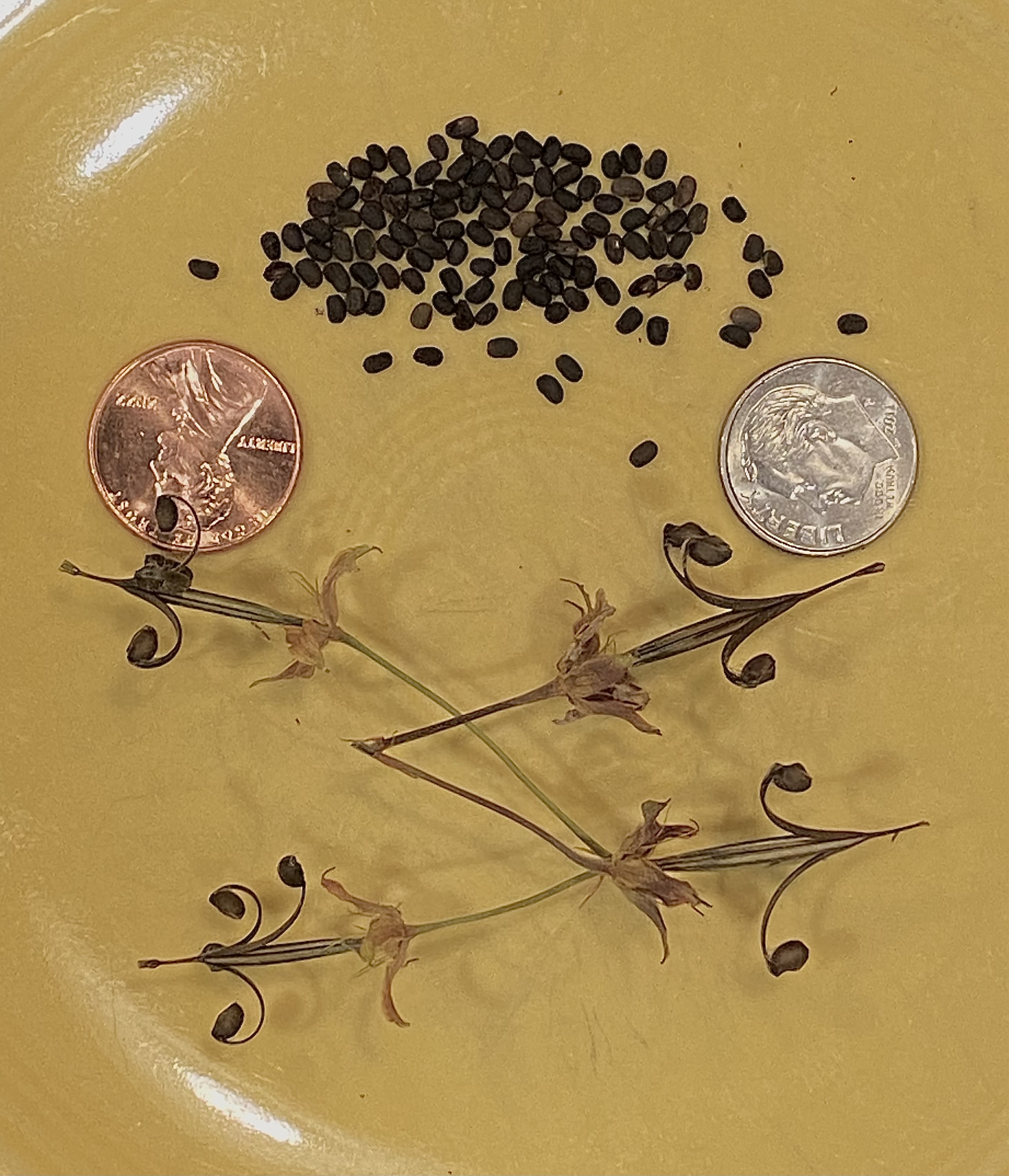
Wild geranium seeds have moisture-dependent conditional dormancy, meaning their dormancy depth changes based on how they're stored after collection. Seeds dispersed naturally from the ballistic capsules (which catapult seeds up to 30 feet away) fall to the forest floor where they remain moist through winter. These continuously moist seeds have only shallow dormancy and will germinate readily in spring after experiencing about 30 days of cold winter conditions. However, if seeds dry out after dispersal or during storage, they develop much deeper dormancy that requires additional treatments beyond cold stratification alone. This moisture-sensitive dormancy mechanism appears to be an adaptation ensuring seeds germinate reliably when they experience the natural forest floor conditions of consistent moisture and winter cold.
Prairie Moon Nursery confirms wild geranium's ballistic seed dispersal mechanism, noting that as the crane's bill-like structure dries, it literally catapults seeds away from the parent plant. Each seed has a small tail-like structure that bends and moves in response to humidity changes, helping drive the seed into soil for germination. Multiple sources confirm the natural spring germination timing, with Illinois Wildflowers noting that seeds mature and are dispersed in early summer, then naturally overwinter on the forest floor before sprouting the following spring.
Based on species patterns: Geranium maculatum seeds typically require cold stratification through winter months to break physiological dormancy. Based on genus patterns: Seeds are dispersed in mid to late summer via explosive capsule dehiscence, then undergo natural cold-moist stratification over winter. Based on general practice: Germination occurs primarily in spring when soil temperatures warm and moisture conditions are favorable. Based on species patterns: Seeds may show variable germination timing, with some germinating immediately in spring and others remaining dormant for an additional year, creating a natural seed bank.
Habitat Notes:(ⓘ Prompt)
Wild geranium grows in rich deciduous forests throughout much of Michigan's Lower Peninsula, especially in moist sites like streamsides, pond borders, wet hollows, and swamps. It's also found in upland oak-hickory forests but is less common there. The seeds have a remarkable ballistic dispersal mechanism - the fruit looks like a bird's long beak with five bumps at the bottom, which are actually seed-containing "ladles." When ripe, these ladles turn brown and then spring upward to catapult seeds up to 30 feet away from the parent plant, finishing in a distinctive chandelier shape.
Beyond forests, wild geranium also grows in woodland edges, meadows, fields, savannas, oak woodlands, prairies, rocky glades, and streambanks across the broader Midwest and eastern North America. The ballistic seed dispersal works through a fascinating hygroscopic (moisture-sensitive) mechanism - each seed has a small tail-like structure that bends and moves in response to changes in humidity, which helps drive the ejected seed into the soil where it can safely germinate.
Based on species patterns: Geranium maculatum typically grows in rich, moist deciduous and mixed forests, often found in maple-beech woods, oak-hickory forests, and along shaded woodland edges. Based on genus patterns: Prefers partial shade to full shade with well-drained, humus-rich soils and can tolerate seasonal moisture variation. Based on species patterns: Seeds are dispersed through an explosive ballistic mechanism where the five-parted capsule suddenly splits and curls upward, flinging seeds several feet from the parent plant when mature and dry, typically occurring in mid to late summer.
BONAP Range Map:

SE Michigan Monthly Observations:
Previously Known As:
Geranium album, Geranium ludovicianum
Common Names:
Wild Geranium, Spotted Geranium, Wood Geranium, Spotted Cranesbill, Wild Cranesbill, Alum Root, Alum Bloom, Old Maid's Nightcap, Crowfoot
Coefficient of Conservatism (C):
4.0
— Prefers natural areas
This plant does best in natural areas but can handle some changes to its environment. Finding it suggests the habitat is in decent shape.
Explained
Coefficient of Wetness (CW):
3.0
— Prefers dry conditions
This plant usually grows in well-drained, drier upland areas and may struggle in wet soils.
Explained
Similar Species / Distinguishing Features:(ⓘ Prompt)
• Native — **Geranium bicknellii** (Bicknell's geranium): Has much smaller flowers (under 1/2 inch across vs 1-1.5 inches), notched petals, and more finely cut leaves. **Geranium pusillum** (small geranium) and **Geranium molle** (dove's-foot geranium): Both have tiny flowers well under 1/2 inch across compared to wild geranium's showy 1+ inch blooms.
• Non-native — **Geranium pratense** (meadow geranium): European species with equally large flowers but sticky-glandular hairs on flower stalks and more finely divided leaves. **Geranium sanguineum** (bloody geranium): Has notched petals and smaller leaves, rarely naturalized. When not flowering, wild geranium leaves may be confused with **Canada anemone** (has sharper teeth and a whorl of 3 stalkless leaves on upper stem) or **black snakeroots** (Sanicula species, which have alternate compound leaves rather than opposite lobed leaves).
• Non-native — **Geranium pratense** (meadow geranium): European species with equally large flowers but sticky-glandular hairs on flower stalks and more finely divided leaves. **Geranium sanguineum** (bloody geranium): Has notched petals and smaller leaves, rarely naturalized. When not flowering, wild geranium leaves may be confused with **Canada anemone** (has sharper teeth and a whorl of 3 stalkless leaves on upper stem) or **black snakeroots** (Sanicula species, which have alternate compound leaves rather than opposite lobed leaves).
• Based on genus patterns:
• Native — Geranium bicknellii (Bicknell's geranium) has smaller flowers, more deeply divided leaves, and typically grows in drier habitats.
• Native — Geranium carolinianum (Carolina geranium) is an annual with smaller pink flowers and more finely dissected leaves.
• Horticultural — Geranium species commonly sold as 'hardy geraniums' or 'cranesbill' in gardens may have different flower colors, leaf shapes, or growth habits but share the characteristic beaked seed capsules. Based on family patterns:
• Non-native — Pelargonium species (commonly called 'geraniums' in horticulture) have asymmetrical flowers, different leaf shapes, and are typically grown as annuals in Michigan, belonging to the same family but different genus.
• Native — Geranium bicknellii (Bicknell's geranium) has smaller flowers, more deeply divided leaves, and typically grows in drier habitats.
• Native — Geranium carolinianum (Carolina geranium) is an annual with smaller pink flowers and more finely dissected leaves.
• Horticultural — Geranium species commonly sold as 'hardy geraniums' or 'cranesbill' in gardens may have different flower colors, leaf shapes, or growth habits but share the characteristic beaked seed capsules. Based on family patterns:
• Non-native — Pelargonium species (commonly called 'geraniums' in horticulture) have asymmetrical flowers, different leaf shapes, and are typically grown as annuals in Michigan, belonging to the same family but different genus.
Wikipedia Summary:
Geranium maculatum, the (wild geranium, spotted geranium, or wood geranium, is a perennial plant native to woodland in eastern North America, from southern Manitoba and southwestern Quebec south to Alabama and Georgia and west to Oklahoma and South Dakota.
Cloudinary Images - Identification
6 images