Alum Root / Coral Bells
Heuchera americana
Species Identification
Information needed to identify the plant in the field
Native-MIFlora:
Native
Duration:
perennial
Height:
1'-2'
Stature:
Ankle
Bloom Color:
White
Compact Bloom Range:
MAY - JUN
Light:
P, Sh
Moisture:
M
Michigan Flora Description:
Deciduous forests, often on dry to moist banks and ravines. Typical plants of this species have the flowers regular or nearly so, and the petioles glabrous to very sparsely hirsute. Most of our plants unfortunately approach Heuchera richardsonii in a tendency to bilaterally symmetrical flowers and very hirsute petioles, and are referred to var. hirsuticaulis (Wheelock) Rosend., Butters, & Lakela. They presumably reflect the influence of hybridization in the past, and the lines between varieties, as well as species, are difficult to draw.
Germination Ecology / Real-World Behavior:(ⓘ Prompt)
American alumroot seeds develop in small capsules with prominent beaks that ripen 3-4 weeks after flowering in mid to late summer. The tiny seeds are dispersed by wind when mature. Seeds require cold, moist stratification over winter to break dormancy - this natural chilling period simulates the species' native woodland conditions where seeds would experience months of cold, damp conditions under snow and leaf litter. Without this cold treatment, seeds typically will not germinate the following spring.
Based on genus patterns: Heuchera seeds are typically dispersed in late summer to early fall when capsules split open and release small seeds that can be carried by wind or water. Based on family patterns: Seeds often exhibit physiological dormancy common in Saxifragaceae, requiring cold-moist stratification to break dormancy mechanisms. Based on genus patterns: Natural germination typically occurs in spring following winter cold exposure, with seeds responding to warming soil temperatures and increased moisture. Based on general practice: Seeds may show variable germination timing in the wild, with some germinating the first spring after dispersal while others may remain dormant for additional seasons until optimal conditions are met.
Habitat Notes:(ⓘ Prompt)
American alumroot grows in deciduous forests, often on dry to moist banks and ravines throughout southeastern Michigan. The small seeds are produced in capsules (dry seed containers that split open) on tall flower stalks that extend well above the basal leaves. When mature, the capsules split open and release the tiny seeds, which are dispersed by wind and gravity. The elevated position of the flower stalks helps catch breezes and allows seeds to scatter away from the parent plant into suitable forest floor locations.
Additionally found in forest edges, rocky woodlands, wooded bluffs, rock outcroppings, and cliff ledges where oak trees are often present. American alumroot tolerates well-drained, rocky or humus-rich soils and prefers partial shade to light shade conditions. The seeds are described as numerous, tiny, and black when mature - small enough to be effectively wind-dispersed from the elevated flower stalks.
Based on species patterns: Heuchera americana typically grows in rich, well-drained soils in partial to full shade, often found in deciduous woodlands, rocky slopes, and cliff faces throughout eastern North America. Based on genus patterns: The plant produces tiny seeds in small capsules that develop from delicate flower spikes held above the foliage on thin stems. Based on general practice: Seeds are dispersed primarily by wind and gravity, with the lightweight seeds shaking out of the opened capsules as the dried flower stalks move in breezes or are disturbed by animals moving through the understory.
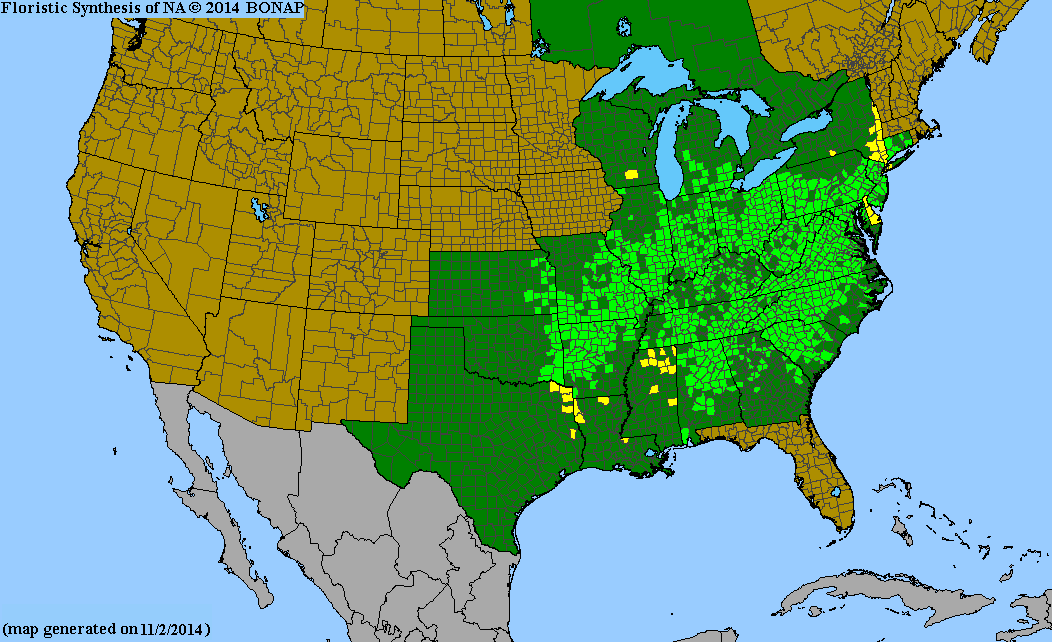
BONAP Range Map:
SE Michigan Monthly Observations:
External Reference URLs:
Previously Known As:
Heuchera calycosa, Heuchera cortusa, Heuchera curtisiae, Heuchera curtisii, Heuchera lancipetala, Heuchera lucida, Heuchera portula, Heuchera scapifera, Heuchera scapigera, Heuchera viscida
Common Names:
American alumroot, rock geranium, coralbells
Coefficient of Conservatism (C):
8.0
— Needs quality habitat
This plant is choosy about where it lives. It strongly prefers natural areas that haven't been heavily disturbed.
Explained
Coefficient of Wetness (CW):
3.0
— Prefers dry conditions
This plant usually grows in well-drained, drier upland areas and may struggle in wet soils.
Explained
Similar Species / Distinguishing Features:(ⓘ Prompt)
• Native — Tiarella cordifolia (foamflower): flowers have 10 stamens in a raceme with unequal capsule valves, versus Heuchera americana's 5 stamens in a panicle-like cluster with equal capsule valves.
• Native — Heuchera richardsonii (prairie alumroot): has longer asymmetrical flowers (5.0–9.0 mm) compared to the shorter, more symmetrical flowers (3.0–4.5 mm) of woodland alumroot.
• Horticultural — Various Heuchera americana cultivars (coral bells): feature more brightly colored flowers and highly variegated foliage compared to the greenish flowers and less showy leaves of wild forms.
• Native — Heuchera richardsonii (prairie alumroot): has longer asymmetrical flowers (5.0–9.0 mm) compared to the shorter, more symmetrical flowers (3.0–4.5 mm) of woodland alumroot.
• Horticultural — Various Heuchera americana cultivars (coral bells): feature more brightly colored flowers and highly variegated foliage compared to the greenish flowers and less showy leaves of wild forms.
• Based on genus patterns:
• Native — Heuchera richardsonii (Richardson's alumroot) has more deeply lobed leaves and typically grows in drier, more alkaline soils.
• Native — Heuchera villosa (hairy alumroot) has more pronounced leaf hairiness and grows primarily in rocky, mountainous areas.
• Native — Tiarella cordifolia (foamflower) has similarly shaped leaves but produces white flower spikes rather than panicles and spreads by stolons.
• Horticultural — Cultivated Heuchera varieties (coral bells) typically have more colorful foliage ranging from purple to chartreuse and may have different flower colors, though leaf shape remains similar.
• Native — Heuchera richardsonii (Richardson's alumroot) has more deeply lobed leaves and typically grows in drier, more alkaline soils.
• Native — Heuchera villosa (hairy alumroot) has more pronounced leaf hairiness and grows primarily in rocky, mountainous areas.
• Native — Tiarella cordifolia (foamflower) has similarly shaped leaves but produces white flower spikes rather than panicles and spreads by stolons.
• Horticultural — Cultivated Heuchera varieties (coral bells) typically have more colorful foliage ranging from purple to chartreuse and may have different flower colors, though leaf shape remains similar.
Wikipedia Summary:
Heuchera americana, or American alumroot, is a small (under 2 ft. high and wide) evergreen perennial native to eastern and central North America in the Saxifrage family.