Blue Flag Iris
Iris virginica
Species Identification
Information needed to identify the plant in the field
Native-MIFlora:
Native
Duration:
perennial
Height:
2'-3'
Stature:
Waist
Bloom Color:
Lt. Blue-Lavender
Compact Bloom Range:
MAY - JUN
Light:
Sn, P, Sh
Moisture:
M, Ms, W
Michigan Flora Description:
Ponds and lake shores, marshes and sedge meadows, ditches, streamsides, river banks and thickets, swamps, and rarely bogs. See discussion under I. versicolor.
Germination Ecology / Real-World Behavior:(ⓘ Prompt)
Southern Blue Flag produces large brown seeds in 3-angled capsules that ripen in late summer. The heavy seed pods often cause weak flower stalks to bend to the ground where seeds finish maturing. When capsules split open, seeds can float on water and disperse via water currents to new wetland areas. Seeds require consistent moisture to remain viable and will lose viability if allowed to dry out during storage or dispersal.
Based on genus patterns: Seeds are typically dispersed in late summer to fall when capsules split open and release seeds that may float briefly before sinking. Based on species patterns: Seeds have a hard seed coat that creates physical dormancy, requiring cold-moist stratification over winter to soften and allow water uptake. Natural germination occurs in spring after soil temperatures warm, typically requiring several months of cold treatment. Based on life-history patterns: As a wetland perennial, germination timing aligns with spring moisture availability and growing season onset.
Habitat Notes:(ⓘ Prompt)
Southern blue flag grows in wet habitats throughout Michigan, including ponds and lake shores, marshes and sedge meadows, ditches, streamsides, river banks and thickets, and swamps. In Southeast Michigan, it can be found in counties like Washtenaw, Wayne, Oakland, Livingston, and Jackson. The seeds develop in distinctive capsules (pods) that split open like banana peels when ripe, revealing terra cotta colored seeds stacked inside. This splitting mechanism allows the seeds to be released and dispersed naturally when the capsule opens.
Seeds can also float on water, spreading to new areas via water currents after the capsules split open. The plants are found in wet to moist black soil prairies, prairie swales, soggy meadows along rivers, open bottomland woodlands, swamps, fens, seeps, and low-lying ground along railroads and roadsides. The flowering stems are often weak and may fall over during flowering, sometimes allowing the heavy seed capsules to reach the ground where they finish ripening.
Based on species patterns: Iris virginica typically inhabits wetland edges, marshes, shallow water margins, and wet meadows in southeastern Michigan. Based on genus patterns: Seeds are large, brown, and cork-like, adapted for water dispersal - they float away from parent plants during spring floods or high water periods before washing ashore to germinate in moist soil. Based on family patterns: The thick seed coat allows extended periods in water without damage, and seeds may remain viable in wet sediments through winter.
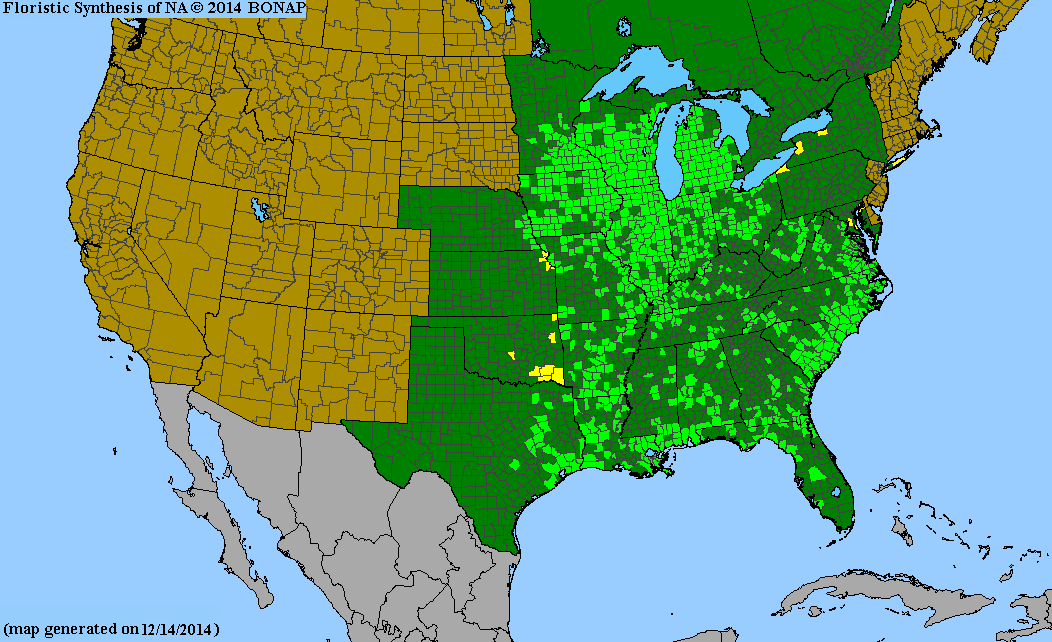
BONAP Range Map:
SE Michigan Monthly Observations:
Previously Known As:
Iris caroliniana, Iris convoluta, Iris georgiana, Iris shrevei, Limniris shrevei, Limniris virginica, Xiphion virginicum
Common Names:
Southern Blue Flag, Virginia Iris, Blue Flag Iris, Virginia Blue Flag
Coefficient of Conservatism (C):
5.0
— Prefers natural areas
This plant does best in natural areas but can handle some changes to its environment. Finding it suggests the habitat is in decent shape.
Explained
Coefficient of Wetness (CW):
-5.0
— Loves wet feet
This plant almost always grows in wetlands. It thrives standing in water or saturated soil.
Explained
Similar Species / Distinguishing Features:(ⓘ Prompt)
• Native — **Iris versicolor** (Northern Blue Flag) is extremely similar and overlaps in range through southern Michigan. Northern Blue Flag typically has richer blue pigmentation on sepal margins that fade toward the throat, more prominent purple veins, and a less defined greenish-yellow throat spot (vs. the sharply defined bright yellow spot in Virginia Iris). Northern Blue Flag also has proportionally shorter center petals (½ to ⅔ sepal length vs. ⅔ to nearly equal length), firmer upright flower stalks, and stem leaves that don't rise above the flowers.
• Non-native — **Iris × germanica** (German Iris) cultivars have conspicuous beards (tufted hairs) on their sepals, while Virginia Iris is beardless.
• Invasive — **Iris pseudacorus** (Yellow Flag) has bright yellow flowers when blooming, but when not in flower can be distinguished by leaves with a prominent raised midvein, while native blue irises have nearly flat leaves with obscure midveins.
• Non-native — **Iris × germanica** (German Iris) cultivars have conspicuous beards (tufted hairs) on their sepals, while Virginia Iris is beardless.
• Invasive — **Iris pseudacorus** (Yellow Flag) has bright yellow flowers when blooming, but when not in flower can be distinguished by leaves with a prominent raised midvein, while native blue irises have nearly flat leaves with obscure midveins.
• Based on species patterns:
• Native — Iris versicolor (blue flag iris) differs by having purple-blue flowers instead of blue-purple, narrower sepals, and preference for wetter habitats.
• Native — Iris prismatica (slender blue flag) is much smaller overall with narrower leaves and smaller flowers.
• Native — Iris lacustris (dwarf lake iris) is significantly shorter, found only near Great Lakes shores, and has much smaller flowers.
• Horticultural — Iris germanica (bearded iris) has prominent fuzzy 'beards' on the falls and blooms earlier in spring.
• Horticultural — Siberian iris cultivars have narrower, more grass-like foliage and smaller flowers without the prominent veining. Based on genus patterns: Various horticultural iris hybrids may escape cultivation but typically show more uniform coloration and larger flower size than native species.
• Native — Iris versicolor (blue flag iris) differs by having purple-blue flowers instead of blue-purple, narrower sepals, and preference for wetter habitats.
• Native — Iris prismatica (slender blue flag) is much smaller overall with narrower leaves and smaller flowers.
• Native — Iris lacustris (dwarf lake iris) is significantly shorter, found only near Great Lakes shores, and has much smaller flowers.
• Horticultural — Iris germanica (bearded iris) has prominent fuzzy 'beards' on the falls and blooms earlier in spring.
• Horticultural — Siberian iris cultivars have narrower, more grass-like foliage and smaller flowers without the prominent veining. Based on genus patterns: Various horticultural iris hybrids may escape cultivation but typically show more uniform coloration and larger flower size than native species.
Wikipedia Summary:
Iris virginica, with the common name Virginia iris, is a perennial species of flowering plant, native to eastern North America.
Cloudinary Images - Identification
3 images

