Wild Lupine
Lupinus perennis
Species Identification
Information needed to identify the plant in the field
Native-MIFlora:
Native
Duration:
perennial
Height:
1'-2'
Stature:
Knee
Bloom Color:
Blue
Compact Bloom Range:
MAY - JUN
Light:
Sn
Moisture:
D
Michigan Flora Description:
Dry usually sandy ground, ranging from prairies and open barrens or clearings to savannas of oak, jack pine, and/or aspen. Quite variable in regard to pubescence on stems and petioles; the most hirsute extreme (tending to be more western in range and well represented in Michigan) has been named var. occidentalis S. Watson. The flowers occasionally exhibit assorted combinations of blue, purple, pink, and white, including entirely white corollas.
Germination Ecology / Real-World Behavior:(ⓘ Prompt)
Wild lupine seeds have a hard seed coat that creates dormancy, requiring scarification (scratching or nicking the seed coat) to allow water penetration for germination. Seeds naturally disperse when mature pods explosively split open in late summer, ejecting seeds several feet from the parent plant. The seeds then undergo natural weathering and temperature cycling over winter. Germination typically occurs in spring after the hard seed coat has been sufficiently broken down by freeze-thaw cycles and soil abrasion. The species can also spread vegetatively through underground rhizomes, forming colonies over time.
Based on genus patterns: Lupinus perennis seeds have a hard, impermeable seed coat that creates physical dormancy, preventing water uptake until the coat is scarified by natural weathering, freeze-thaw cycles, or microbial activity. Based on species patterns: Seeds typically disperse in mid to late summer when pods dry and split explosively. The hard seed coat allows seeds to persist in soil for multiple years, with germination occurring sporadically over several growing seasons as individual seeds become permeable. Based on general practice: Natural germination primarily occurs in spring when soil temperatures warm and moisture is adequate, though some seeds may germinate in fall under favorable conditions.
Habitat Notes:(ⓘ Prompt)
Wild lupine grows in dry, sandy soils across a range of open to partially shaded habitats in Michigan. It thrives in prairies, open barrens, clearings, and oak savannas, as well as areas with jack pine and aspen trees. The species produces seeds in pods that develop after the distinctive blue, purple, pink, or white flower spikes fade. Wild lupine belongs to the legume family (Fabaceae), so its seeds develop in pods that eventually dry and split open, releasing the hard, bean-like seeds to the ground nearby.
Wild lupine is also found in sand hills, clearings, open woods, meadows, fields, and human-disturbed habitats like roadsides and rights-of-way. The seeds develop in hairy pods that explosively split open when mature, forcibly ejecting the hard seeds several feet away from the parent plant. This ballistic dispersal mechanism helps the species colonize new sandy areas and spread across suitable habitat.
Based on species patterns: Wild lupine typically occurs in sandy soils of oak savannas, pine barrens, and open woodlands throughout the Great Lakes region. Based on genus patterns: Seeds are contained in hairy pods that split explosively when dry, projecting seeds several feet from the parent plant. The pods twist as they dry in summer heat, creating tension that suddenly releases to scatter the hard, bean-like seeds. Based on general practice: This ballistic dispersal mechanism allows lupine to colonize nearby open areas while maintaining proximity to suitable mycorrhizal associations in the soil.
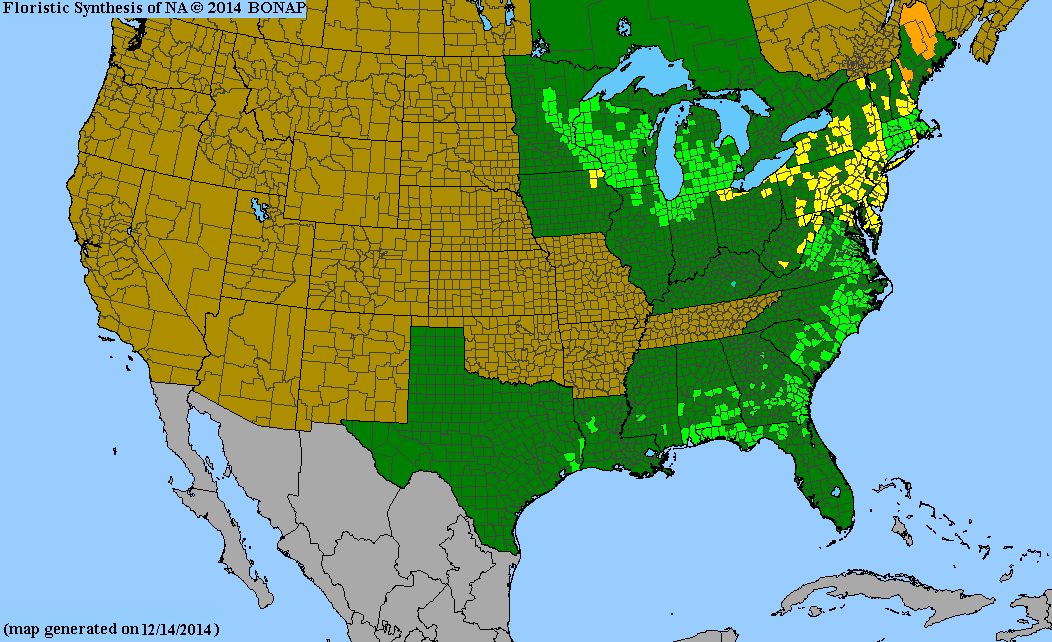
BONAP Range Map:
SE Michigan Monthly Observations:
Common Names:
Wild Lupine, Sundial Lupine, Blue Lupine, Old Maid's Bonnets, Indian Beet
Coefficient of Conservatism (C):
7.0
— Needs quality habitat
This plant is choosy about where it lives. It strongly prefers natural areas that haven't been heavily disturbed.
Explained
Coefficient of Wetness (CW):
5.0
— Needs dry ground
This plant almost never grows in wetlands. It needs well-drained soil and can rot in soggy conditions.
Explained
Similar Species / Distinguishing Features:(ⓘ Prompt)
• Native — **Lupinus polyphyllus** (Large-leaved Lupine): Invasive western species commonly confused with native sundial lupine; has 11-17 leaflets (vs. 7-11), taller flower spikes, larger pointed leaflets, and flowers range from white to pink to purple.
• Native — **Baptisia species** (Wild Indigos): Distinguished by having only 3 leaflets per compound leaf instead of lupine's 7-11 palmate leaflets, though both are in the pea family with similar blue flowers.
• Native — **Baptisia species** (Wild Indigos): Distinguished by having only 3 leaflets per compound leaf instead of lupine's 7-11 palmate leaflets, though both are in the pea family with similar blue flowers.
Based on genus patterns: Other Lupinus species can be distinguished by flower color (L. polyphyllus has blue/purple/white spikes vs. the blue flowers of L. perennis), leaf shape variations, and growth habit differences. Based on family patterns: Legumes like wild indigo (Amorpha species) share similar compound leaves but lack the distinctive palmate leaf arrangement and have different flower structures. Baptisia species (false indigos) are frequently confused due to similar blue flowers and legume family traits, but typically have trifoliate rather than palmate leaves. Based on general practice: Distinguishing features often become clearer during flowering, as lupines have characteristic pea-like flowers in terminal racemes, while many look-alikes have different inflorescence types or flower arrangements.
Wikipedia Summary:
Lupinus perennis (also wild perennial lupine, wild lupine, sundial lupine, blue lupine, Indian beet, or old maid's bonnets) is a medicinal plant in the Fabaceae family. It is widespread in the eastern part of the USA (from Texas and Florida to Maine) and Minnesota, Canada (southern Ontario, Newfoundland and Labrador), and on the coasts of the Arctic Ocean, where it grows on sand hills and roadsides.