Hairy Beardtongue
Penstemon hirsutus
Species Identification
Information needed to identify the plant in the field
Native-MIFlora:
Native
Duration:
perennial
Height:
1'-2'
Stature:
Knee
Bloom Color:
Blue
Compact Bloom Range:
MAY - JUL
Light:
Sn, P
Moisture:
D, M
Michigan Flora Description:
Sandy, barren, open, usually dry ground, including prairies, oak savanna and borders, fields, roadsides; stream and river banks, rocky ground. The rare white-flowered form has been called f. albiflorus Farw. This is our most frequent species in southern Michigam, and clearly native there. Northern occurrences are less certainly native.
Germination Ecology / Real-World Behavior:(ⓘ Prompt)
Seeds benefit from cold stratification for best germination. In nature, seeds disperse from capsules in late summer to fall and experience winter's cold, wet conditions that break dormancy. Seeds typically germinate in spring after receiving these natural conditioning signals.
Based on genus patterns: Seeds disperse in late summer to fall after capsules dry and split open. Based on family patterns: Seeds typically exhibit physiological dormancy requiring cold stratification to break internal germination blocks. Based on genus patterns: Natural germination occurs in spring following winter's cold-moist conditions, with seedlings emerging as soil warms. Based on general practice: Seeds may remain viable in soil for multiple seasons if conditions aren't suitable for germination in the first spring.
Habitat Notes:(ⓘ Prompt)
Hairy beard-tongue grows in sandy, barren, open, and usually dry ground throughout southern Michigan, including prairies, oak savannas and their borders, fields, and roadsides. It also establishes along stream and river banks and on rocky ground. The species thrives in disturbed areas and is most commonly found in southern Michigan counties. Seeds are produced in small capsules (dry seed containers that split open) and are likely dispersed by wind and gravity when the mature capsules split, allowing the small seeds to scatter from the upright flower stalks.
Extends beyond dry sandy areas to include dry woods, rocky fields, bluffs, meadows and fields, cliffs, balds, ledges, and woodlands. Tolerates a wide range of sun exposure from full sun to full shade, and soil moisture from medium-wet to dry conditions, making it more adaptable than strictly dry-ground specialists. Grows well in thin, well-drained soils including clay. The capsules split by two main valves to release small seeds with reticulate (net-like) surface markings.
Based on species patterns: Penstemon hirsutus typically grows in dry to mesic open areas including prairies, woodland edges, and rocky slopes with well-drained soils. Based on genus patterns: Prefers full sun to partial shade and tolerates sandy or gravelly soils common in Great Lakes region habitats. Based on family patterns: Seeds are small and produced in capsules that split open when mature, releasing seeds for wind dispersal over short distances. Based on general practice: Seeds typically fall close to parent plants and may be collected by shaking mature capsules into containers during late summer to early fall.
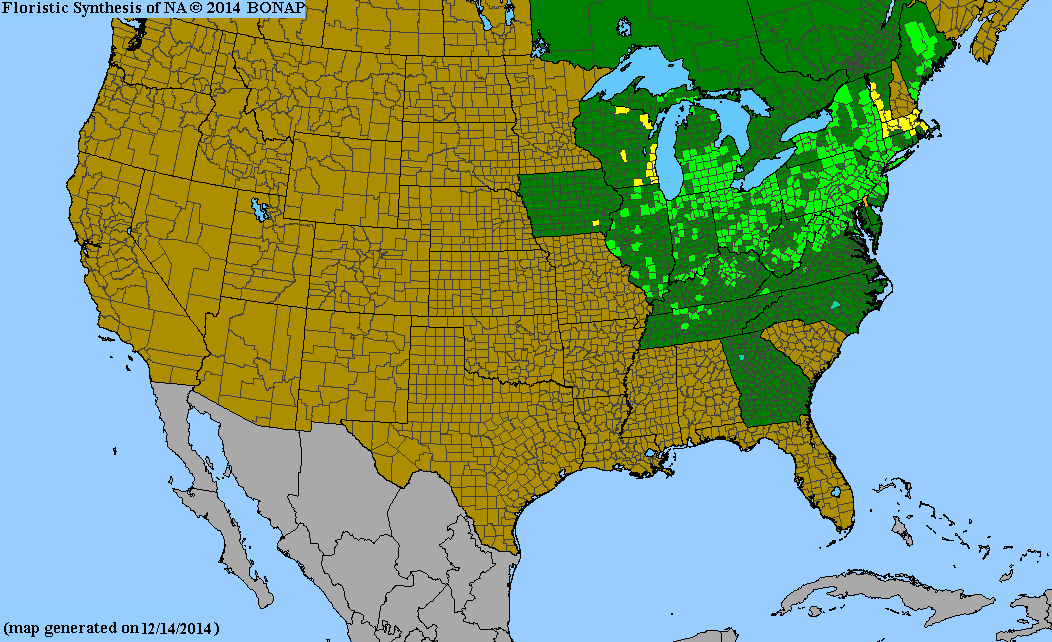
BONAP Range Map:
SE Michigan Monthly Observations:
External Reference URLs:
Previously Known As:
Bartramia concinna, Chelone hirsuta, Chelone pubescens, Chelone pubescens, Penstemon amplexicaulis, Penstemon crassifolius, Penstemon crassifolius, Penstemon latifolius, Penstemon longifolius, Penstemon mackayanus, Penstemon pentstemon, Penstemon pubescens
Common Names:
hairy beardtongue, northeastern beardtongue, hairy penstemon
Coefficient of Conservatism (C):
5.0
— Prefers natural areas
This plant does best in natural areas but can handle some changes to its environment. Finding it suggests the habitat is in decent shape.
Explained
Coefficient of Wetness (CW):
5.0
— Needs dry ground
This plant almost never grows in wetlands. It needs well-drained soil and can rot in soggy conditions.
Explained
Similar Species / Distinguishing Features:(ⓘ Prompt)
• Native — **Penstemon digitalis** (Foxglove Beardtongue): Taller plant with white flowers and smooth (hairless) stems, contrasting with P. hirsutus's purple flowers and distinctly hairy stems. **Penstemon calycosus** (Long-sepal Beardtongue): Has longer sepals and different geographic range, though both have hairy stems.
Based on genus patterns: Other Penstemon species are the most common source of confusion, particularly P. digitalis (foxglove beardtongue) which has smoother, less hairy leaves and typically white flowers, and P. calycosus which has broader leaves and different flower coloration. Based on family patterns: Scrophulariaceae members like Chelone glabra (turtlehead) may appear similar in flower structure but typically have opposite leaves and different habitat preferences. Based on general botanical patterns: Some Veronica species might be confused when not in flower due to similar leaf arrangements, though flowers are distinctly different when present.
Wikipedia Summary:
Penstemon hirsutus is a species of flowering plant in the plantain family known by the common name hairy beard-tongue. It is native to the eastern Canada and the United States.