Virginia mountain mint
Pycnanthemum virginianum
Species Identification
Information needed to identify the plant in the field
Native-MIFlora:
Native
Duration:
perennial
Height:
3'
Stature:
Waist
Bloom Color:
White
Compact Bloom Range:
JUN - SEP
Light:
Sn, P
Moisture:
D, M, Ms, W
Michigan Flora Description:
Fens, prairies, marshes, sedge meadows, tamarack swamps, swales, depressions such as old lakebeds; fields, sandy banks; less often in forested areas. This is our only common species in the genus, and a fairly distinctive one, with the angles of the main stem usually copiously pubescent and the sides rarely with a few small hairs. The leaves are variable in size, shape, and pubescence.
Germination Ecology / Real-World Behavior:(ⓘ Prompt)
Virginia mountain mint disperses tiny black nutlets (seeds) in late summer to early fall, with wind helping carry the small seeds short distances. The seeds appear to have minimal dormancy requirements and can germinate the following spring without special treatment. Seeds naturally experience winter conditions that prepare them for germination when temperatures warm and moisture increases in spring. The plant also spreads vegetatively through short rhizomes, forming small colonies over time.
Based on genus patterns: Seeds typically disperse in late fall through winter after capsules split open, with small nutlets falling near the parent plant or being carried short distances by wind. Based on family patterns: Seeds commonly exhibit physiological dormancy requiring cold-moist stratification, with germination occurring in spring after winter chilling breaks dormancy. Based on general practice: Natural germination timing aligns with spring warming after adequate cold exposure, typically when soil temperatures consistently reach 50-60°F and moisture conditions are favorable.
Habitat Notes:(ⓘ Prompt)
Common mountain mint grows in diverse wet to moderately dry habitats across Michigan, including fens, prairies, marshes, sedge meadows, tamarack swamps, and sandy fields. Despite its mountain name, this species thrives in flatland environments from dry-mesic to wet conditions. The seeds are dispersed as "shakers" - they drop very close to the parent plant when loosened by wind or passing animals. When the grayish flower heads ripen, seeds easily spill out of the clustered tubes when the plant is shaken or disturbed.
Additional habitats include wet prairies, stream edges, moist bluffs, prairie swales, wet meadows in woodland areas, thickets, swamps, rocky bluffs, and areas along creek banks. This species is also found in anthropogenic (human-disturbed) habitats, meadows and fields, and along railroad tracks. The seeds are described as tiny, finely pitted, and dull black nutlets that are distributed to some extent by the wind, though the plant primarily forms small colonies through short rhizomes.
Based on species patterns: Virginia mountain mint typically grows in moist to moderately dry soils in prairies, meadows, old fields, and woodland edges throughout southeastern Michigan. Based on genus patterns: The plant forms colonies through underground rhizomes, creating dense patches over time. Based on family patterns: Seeds are small nutlets (about 1mm) that develop within persistent calyxes and disperse primarily by gravity and water movement during fall and winter storms. Based on general practice: The dried flower heads often persist through winter, gradually releasing seeds as stems break or bend, allowing for both local and somewhat distant dispersal when carried by surface water flow.
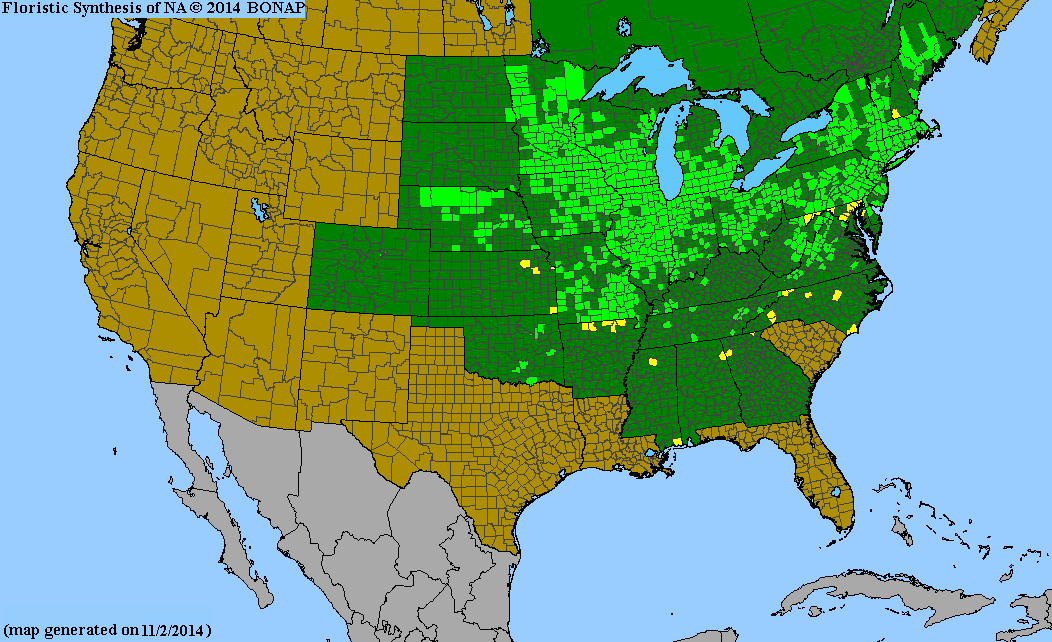
BONAP Range Map:
SE Michigan Monthly Observations:
Previously Known As:
Brachystemum lanceolatum, Brachystemum virginicum, Koellia lanceolata, Koellia virginiana, Koellia virginiana, Koellia virginiana, Koellia virginica, Nepeta virginica, Pycnanthemum lanceolatum, Satureja virginiana, Satureja virginica, Thymus lanceolatus, Thymus verticillatus, Thymus virginicus, Thymus virginicus
Common Names:
Virginia Mountain Mint, Common Mountain Mint, Virginia Mountainmint
Coefficient of Conservatism (C):
5.0
— Prefers natural areas
This plant does best in natural areas but can handle some changes to its environment. Finding it suggests the habitat is in decent shape.
Explained
Coefficient of Wetness (CW):
-3.0
— Prefers wet conditions
This plant is usually found in wetlands or very moist areas, but can sometimes grow in drier spots.
Explained
Similar Species / Distinguishing Features:(ⓘ Prompt)
• Native — **Slender Mountain Mint (Pycnanthemum tenuifolium)** can be very difficult to distinguish from Virginia Mountain Mint. Slender Mountain Mint has consistently narrow leaves (under ¼ inch wide) with a needle-like appearance, and hairless stems along the ridges. Virginia Mountain Mint has wider leaves (some over ¼ inch), more variable leaf shapes, and white hairs along the stem ridges.
• Native — **Northern Bedstraw (Galium boreale)** has similar small white flower clusters and can look surprisingly similar at first glance. However, Northern Bedstraw has leaves arranged in whorls of 4 around the stem, flowers with 4 petals each, and a subtle sweet-floral fragrance rather than the strong minty scent of Mountain Mint.
• Native — **Northern Bedstraw (Galium boreale)** has similar small white flower clusters and can look surprisingly similar at first glance. However, Northern Bedstraw has leaves arranged in whorls of 4 around the stem, flowers with 4 petals each, and a subtle sweet-floral fragrance rather than the strong minty scent of Mountain Mint.
• Based on genus patterns: Other Pycnanthemum species are the most commonly confused taxa, particularly P. muticum (clustered mountain mint) which has broader, less lance-shaped leaves and P. tenuifolium (narrow-leaved mountain mint) with very narrow linear leaves compared to P. virginianum's intermediate leaf width. Based on family patterns:
• Native — Wild bergamot (Monarda fistulosa) shares similar habitat and mint family characteristics but has larger, showier flowers and lacks the dense white-topped flower clusters.
• Native — Calamint species have similar aromatic foliage but typically smaller stature and different flower arrangement. Based on general botanical patterns:
• Non-native — European pennyroyal and other introduced mints may occur in similar disturbed habitats but typically have different leaf shapes and flower structures.
• Native — Wild bergamot (Monarda fistulosa) shares similar habitat and mint family characteristics but has larger, showier flowers and lacks the dense white-topped flower clusters.
• Native — Calamint species have similar aromatic foliage but typically smaller stature and different flower arrangement. Based on general botanical patterns:
• Non-native — European pennyroyal and other introduced mints may occur in similar disturbed habitats but typically have different leaf shapes and flower structures.
Wikipedia Summary:
Pycnanthemum virginianum, the Virginia or common mountain-mint, is a plant in the mint family, Lamiaceae. It is a herbaceous plant with narrow, opposite, simple leaves, on wiry, green stems. The flowers are white with purplish spotting, borne in summer. Like most plants in the genus, the foliage has a strong mint fragrance when crushed or disturbed. It is native to the eastern United States and eastern Canada.
Cloudinary Images - Identification
3 images

