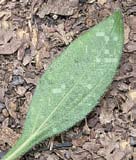
Black-eyed Susan
Rudbeckia hirta
Species Identification
Information needed to identify the plant in the field
Native-MIFlora:
Native
Duration:
perennial
Height:
1'-3'
Stature:
Waist
Bloom Color:
Yellow
Compact Bloom Range:
JUL - OCT
Light:
Sn, P
Moisture:
D, M, Ms
Michigan Flora Description:
Fields, roadsides, railroads, clearings, fencerows; savanna (with jack pine, aspen, oak), especially in sandy or rocky openings; prairies, fens, sedge meadows, shores; gravel and borrow pits, other disturbed sites. This is a complex species consisting, according to some authors, of as many as 4 or 5 intergrading varieties. It is also cultivated, especially as large tetraploid cultivars “Gloriosa Daisy.” Most of our plants are the rather weedy var. pulcherrima Farw. A few are apparently var. hirta , with broader, elliptic-ovate lower leaves, an eastern variety characteristic of undisturbed habitats. The size and color of the rays (and also the disk), the shape and toothing and size of the leaves, and the amount of pubescence on the receptacular chaff are all quite variable. The rays are rarely bicolored, more numerous than usual (heads “double”), or lacking, mostly in escapes of cultivars.
Germination Ecology / Real-World Behavior:(ⓘ Prompt)
Black-eyed Susan seeds mature and are dispersed in fall, about 3-4 weeks after flowering ends. The small, dark seeds (achenes) have no fluffy dispersal structures and typically fall close to the parent plant or are scattered by wind and animals. Seeds require cold stratification over winter to break dormancy—they need several months of cold, moist conditions to germinate successfully. In nature, seeds germinate primarily in spring after experiencing winter's freezing and thawing cycles. The species acts as a biennial or short-lived perennial, with some plants potentially blooming in their first year from spring-planted seed, though most follow a typical biennial pattern of vegetative growth in year one and flowering in year two.
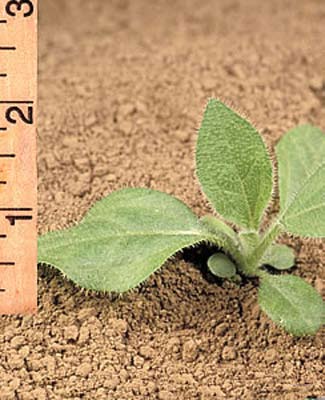
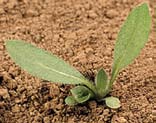
Based on species patterns: Rudbeckia hirta seeds disperse in late fall through winter, with mature seed heads persisting on stems and releasing seeds gradually through wind and weather. Based on genus patterns: Seeds exhibit physiological dormancy requiring cold-moist stratification, typically needing 30-90 days of winter conditions to break dormancy. Natural germination occurs in early to mid-spring when soil temperatures warm and day length increases. Based on life-history patterns: As a short-lived perennial or biennial, seeds may also germinate in fall and overwinter as small rosettes, blooming the following summer.
Habitat Notes:(ⓘ Prompt)
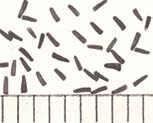
Black-eyed susan grows in a wide variety of habitats across Michigan, from disturbed sites like fields, roadsides, and gravel pits to natural areas including prairies, fens, sedge meadows, and oak savannas with sandy or rocky openings. It's particularly common in the weedy variety that thrives in disturbed ground, making it a valuable restoration species that blooms quickly after seeding but eventually gives way to more conservative native plants. The seeds are small, dark achenes (dry seeds) that look like graphite from a mechanical pencil, produced in the distinctive cone-shaped center that remains after the yellow petals fall. Wind and gravity help scatter the lightweight seeds from the elevated seed head, though many also fall directly beneath the parent plant.
Black-eyed susan also thrives in mesic to dry prairies, oak savannas, limestone glades, and open rocky areas within upland forests. In developed areas beyond roadsides, it colonizes pastures, abandoned fields, railroad corridors, eroded clay slopes, and various waste areas, recovering moderately well from fires. The plant serves as an excellent pioneer species for prairie restorations, often blooming in the first year from seed but eventually yielding to longer-lived perennial plants as they mature. The small black achenes (dry seeds) are produced abundantly - up to 1.5 million seeds per pound - and are dispersed primarily by wind and gravity from the elevated cone-shaped seed head, with many seeds also falling directly beneath the parent plant to establish local colonies.
Based on species patterns: Rudbeckia hirta typically grows in open, disturbed habitats including roadsides, fields, prairies, and sunny edges with well-drained soils. Based on family patterns: Seeds are small, angular achenes without pappus that disperse primarily by gravity and short-distance wind movement when dried seed heads are shaken by wind or disturbed by animals. Based on general practice: Seed heads often persist through winter, with seeds gradually released over several months as stems bend and heads break apart.
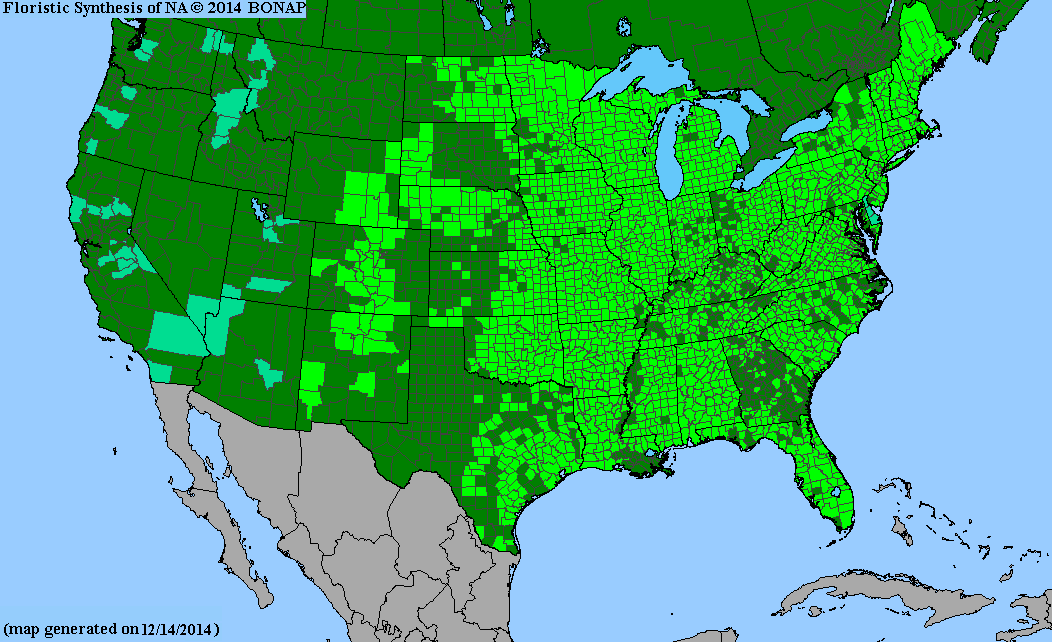
BONAP Range Map:
SE Michigan Monthly Observations:
Previously Known As:
Centrocarpha gracilis, Centrocarpha gracilis, Centrocarpha hirta, Centrocarpha hirta, Coreopsis hirta, Coreopsis hirta, Coreopsis hirta, Helianthus hirtus, Peramibus hirtus, Rudbeckia amplectens, Rudbeckia brittonii, Rudbeckia discolor, Rudbeckia gracilis
Common Names:
Black-eyed Susan, Brown-eyed Susan, Brown Betty, Gloriosa Daisy, Golden Jerusalem, English Bull's Eye, Poor-land Daisy, Yellow Daisy, Yellow Ox-eye Daisy
Coefficient of Conservatism (C):
1.0
— Found almost anywhere
This plant grows in all kinds of places, including roadsides and disturbed areas. It's a survivor that isn't picky about conditions.
Explained
Coefficient of Wetness (CW):
3.0
— Prefers dry conditions
This plant usually grows in well-drained, drier upland areas and may struggle in wet soils.
Explained
Similar Species / Distinguishing Features:(ⓘ Prompt)
• **
• Horticultural — ** Gloriosa Daisy cultivars are tetraploid (doubled chromosome) versions of black-eyed Susan, often with larger flowers, bicolored rays (petals), double flowers, or sometimes no rays at all. **
• Native — ** Rudbeckia hirta var. hirta (the straight species) has broader, elliptic-ovate lower leaves and is found in undisturbed eastern habitats, while the more common var. pulcherrima has narrower stem leaves (less than 3 cm wide) and is more weedy in disturbed sites.
• Horticultural — ** Gloriosa Daisy cultivars are tetraploid (doubled chromosome) versions of black-eyed Susan, often with larger flowers, bicolored rays (petals), double flowers, or sometimes no rays at all. **
• Native — ** Rudbeckia hirta var. hirta (the straight species) has broader, elliptic-ovate lower leaves and is found in undisturbed eastern habitats, while the more common var. pulcherrima has narrower stem leaves (less than 3 cm wide) and is more weedy in disturbed sites.
• **
• Native — ** Rudbeckia fulgida (Orange Coneflower) has a minute crown pappus (tuft) on the seeds, spreads by stolons (runners), shorter receptacle chaff (2.5-4 mm), and usually blooms later with shorter, more rounded style-tips. **
• Native — ** Rudbeckia bicolor is an annual lacking basal leaf tufts, with leaves that remain relatively constant in size and are all stalkless or nearly so, versus black-eyed Susan's basal leaf arrangement with lower leaves on distinct stalks.
• Native — ** Rudbeckia fulgida (Orange Coneflower) has a minute crown pappus (tuft) on the seeds, spreads by stolons (runners), shorter receptacle chaff (2.5-4 mm), and usually blooms later with shorter, more rounded style-tips. **
• Native — ** Rudbeckia bicolor is an annual lacking basal leaf tufts, with leaves that remain relatively constant in size and are all stalkless or nearly so, versus black-eyed Susan's basal leaf arrangement with lower leaves on distinct stalks.
• Based on genus patterns:
• Native — Rudbeckia fulgida (orange coneflower) has darker, more persistent leaves and typically perennial growth habit, while R. hirta is often biennial with lighter green foliage.
• Native — Rudbeckia laciniata (cutleaf coneflower) grows much taller with deeply divided leaves versus R. hirta's simple to slightly lobed leaves.
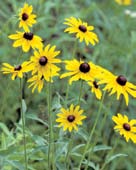
• Native — Heliopsis helianthoides (false sunflower) has similar yellow petals but green-centered discs rather than the dark brown-purple centers typical of R. hirta.
• Horticultural — Cultivated Rudbeckia varieties often show doubled petals or altered colors, while wild R. hirta maintains single-layered yellow petals around dark centers. Based on family patterns:
• Non-native — Helianthus species (sunflowers) can appear similar but typically grow much larger with broader leaves and larger flower heads than R. hirta.
• Native — Rudbeckia fulgida (orange coneflower) has darker, more persistent leaves and typically perennial growth habit, while R. hirta is often biennial with lighter green foliage.
• Native — Rudbeckia laciniata (cutleaf coneflower) grows much taller with deeply divided leaves versus R. hirta's simple to slightly lobed leaves.
• Native — Heliopsis helianthoides (false sunflower) has similar yellow petals but green-centered discs rather than the dark brown-purple centers typical of R. hirta.
• Horticultural — Cultivated Rudbeckia varieties often show doubled petals or altered colors, while wild R. hirta maintains single-layered yellow petals around dark centers. Based on family patterns:
• Non-native — Helianthus species (sunflowers) can appear similar but typically grow much larger with broader leaves and larger flower heads than R. hirta.
Wikipedia Summary:
Rudbeckia hirta, commonly called black-eyed Susan, is a North American flowering plant in the sunflower family, native to Eastern and Central North America and naturalized in the Western part of the continent as well as in China. It has now been found in all 10 Canadian Provinces and all 48 of the states in the contiguous United States.
Cloudinary Images - Identification
8 images