Hoary Skullcap
Scutellaria incana
Species Identification
Information needed to identify the plant in the field
Native-MIFlora:
Native
Duration:
perennial
Height:
3'
Stature:
Waist
Bloom Color:
Blue
Compact Bloom Range:
JUN - SEP
Light:
P
Moisture:
M
Michigan Flora Description:
A species of dry open forests and thickets, but with no extant occurrences known. This species was collected by the First Survey in 1838 in both Calhoun and Kalamazoo Cos., but not since. Additional very old specimens attributed to Michigan, unfortunately without further locality or date, include a sheet in GH, labeled in the hand of Asa Gray and two sheets in MICH labeled in later hands. These may be duplicates of the First Survey collections with complete labels (at NA); one of the MICH sheets especially is plausibly a duplicate of the Kalamazoo Co. collection. Or possibly these are additional collections made by the First Survey. Scutellaria incana is known from northern Ohio and Indiana, and thus is not wholly unexpected in Michigan.
Germination Ecology / Real-World Behavior:(ⓘ Prompt)
Hoary Skullcap flowers bloom from mid- to late summer and are replaced by oddly shaped capsules that contain 2-4 nutlets. At maturity, these capsules turn brown and split open to release their nutlets, which may be facilitated by raindrop dispersal. Seeds are ready for collection in early fall. The plant also spreads through its rhizomatous root system, forming tight colonies of clonal plants. No specific information about seed dormancy mechanisms or germination timing is provided in available sources.
Based on genus patterns: Scutellaria species typically produce seeds in late summer to early fall that disperse locally near the parent plant. Based on family patterns: Seeds in the mint family often have physiological dormancy requiring cold-moist stratification to break internal chemical inhibitors. Based on genus patterns: Natural germination typically occurs in spring following winter conditioning, with seedlings emerging as soil warms and daylight increases. The dormancy mechanism helps prevent germination during unfavorable winter conditions, ensuring seedlings emerge when resources and growing conditions are optimal.
Habitat Notes:(ⓘ Prompt)
Downy skullcap grows in upland forests, rocky woodland slopes, thinly wooded bluffs, rocky riverbanks, upland meadows within wooded areas, and thickets. It prefers partial sun with mesic to dry-mesic conditions, tolerating soils with loam, clay-loam, or rocky material. The plant spreads both by seeds and through underground stems (rhizomes) that can form tight colonies. Seeds develop in oddly-shaped capsules with a concave upper surface - when mature, these capsules turn brown and split open to release 2-4 small nutlets, a process that may be helped along by raindrops hitting the opened capsules.
Based on genus patterns: Scutellaria species typically inhabit dry to mesic soils in open woodlands, prairie edges, and rocky slopes with partial to full sun exposure. Based on species patterns: Scutellaria incana specifically favors calcareous soils and limestone-derived substrates, often found in oak savannas and dry prairies in the Great Lakes region. Based on family patterns: Seeds are produced in small nutlets typical of Lamiaceae, developing within the characteristic two-lipped calyx that persists after flowering. The mature calyx acts as a dispersal unit, with the upper lip forming a lid-like structure that opens to release the nutlets when dry. Seeds disperse primarily by gravity and secondary transport by ants attracted to small oil-rich structures on the seed surface.
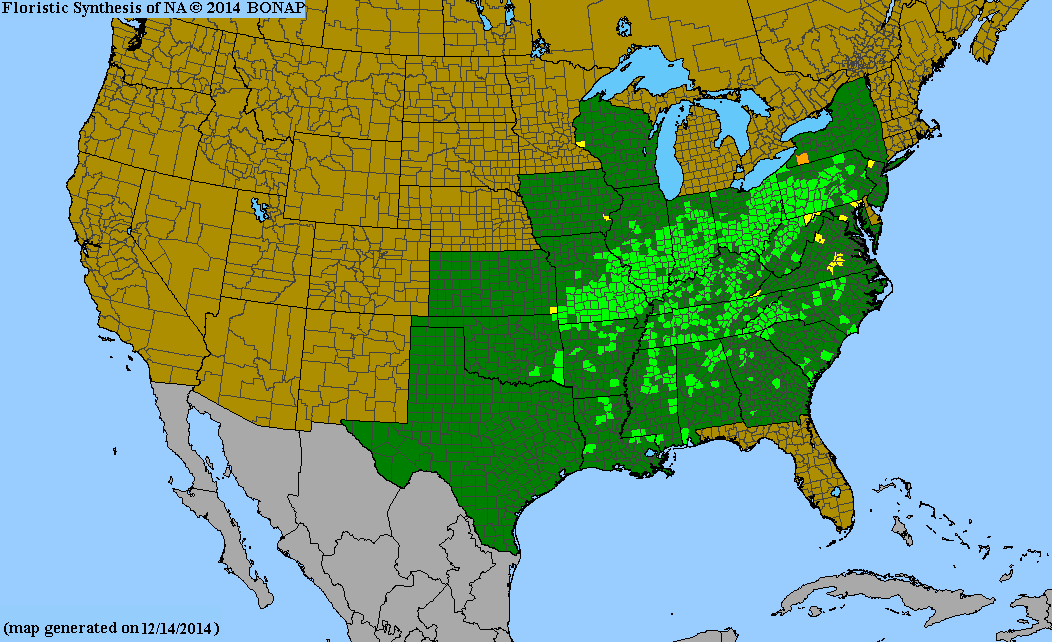
BONAP Range Map:
SE Michigan Monthly Observations:
External Reference URLs:
Common Names:
Hoary Skullcap, Downy Skullcap, Gray Skullcap
Coefficient of Conservatism (C):
10.0
— Rare habitat specialist
This plant only thrives in high-quality natural areas. Finding it is a sign you're in a special place worth protecting.
Explained
Coefficient of Wetness (CW):
5.0
— Needs dry ground
This plant almost never grows in wetlands. It needs well-drained soil and can rot in soggy conditions.
Explained
Similar Species / Distinguishing Features:(ⓘ Prompt)
• Native — **Heart-leaved Skullcap (Scutellaria ovata)** has heart-shaped leaf bases, while Downy Skullcap has well-rounded leaf bases except on the lowest leaves.
• Native — **Mad-dog Skullcap (Scutellaria lateriflora)** produces flowers from leaf axils rather than in terminal spikes, and typically grows shorter.
• Native — **Small Skullcap (Scutellaria parvula)** is much smaller overall and blooms earlier in the season.
• Native — **Anise Hyssop (Agastache foeniculum)** has similar foliage appearance and habitat preferences, but produces smaller, less showy flowers and has an anise scent.
• Native — **Mad-dog Skullcap (Scutellaria lateriflora)** produces flowers from leaf axils rather than in terminal spikes, and typically grows shorter.
• Native — **Small Skullcap (Scutellaria parvula)** is much smaller overall and blooms earlier in the season.
• Native — **Anise Hyssop (Agastache foeniculum)** has similar foliage appearance and habitat preferences, but produces smaller, less showy flowers and has an anise scent.
Based on genus patterns: Scutellaria species are commonly confused with each other due to similar square stems and two-lipped flowers. Based on family patterns: Other Lamiaceae genera like Prunella (self-heal) and Stachys (hedge nettle) share the square stem characteristic but typically have different flower arrangements. Based on general practice: Distinguishing Scutellaria incana from congeners often requires attention to leaf surface texture (the 'incana' epithet suggests gray or hoary pubescence), flower size, and habitat preferences, though specific distinguishing features vary considerably across the genus.
Wikipedia Summary:
Scutellaria incana, the hoary skullcap or downy skullcap, is a flowering plant in the family Lamiaceae and is native to North America. It is a perennial and is primarily found in the eastern United States as well as some parts of the Midwest.