Mad-dog/Blue/Side-Flowering Skullcap
Scutellaria lateriflora
Species Identification
Information needed to identify the plant in the field
Native-MIFlora:
Native
Duration:
perennial
Height:
2'
Stature:
Knee
Bloom Color:
Blue
Compact Bloom Range:
JUL - SEP
Light:
Sn, P
Moisture:
Ms, W
Michigan Flora Description:
Hardwood and conifer swamps, thickets, wet shores, meadows, river banks, ditches and swales, marshes, and bogs. In much the same diversity of wet habitats as the equally common S. galericulata , but the latter seems more often to be in open places and S. lateriflora more often in shaded ones. Plants with white corollas, f. albiflora (Farw.) Fernald, are rare. Depauperate plants very rarely have the racemes reduced to a single flower, but are identifiable by the very small size of the flowers together with petiolate leaves. Plants intermediate with S. galericulata , with intermediate-shaped petiolate leaves and larger flowers (ca. 10–12 mm) than in S. lateriflora , borne singly or in few-flowered racemes, are presumably hybrids, S. × churchilliana Fernald. The only Michigan collections seen are from Gogebic and Marquette Cos.
Germination Ecology / Real-World Behavior:(ⓘ Prompt)
Mad-dog skullcap produces small nutlets (seeds) that mature in late summer to fall after the flowering period. The seeds appear to have minimal dormancy requirements and can germinate relatively easily without extensive pre-treatment. In nature, the seeds likely disperse locally around the parent plant and germinate the following spring when soil moisture and temperature conditions are favorable. The plant spreads both by seed and by rhizomes (underground stems), allowing it to form small colonies in suitable wetland habitats.
Based on genus patterns: Seeds typically disperse in late summer to early fall after the small nutlets mature and drop from the calyx. Based on family patterns: Lamiaceae seeds often exhibit physiological dormancy requiring a period of after-ripening or cold stratification. Based on general practice: Natural germination occurs in spring following winter conditioning, with seeds responding to warming soil temperatures and increased moisture. The nutlets may require 60-90 days of cold-moist conditions to break dormancy and achieve uniform germination.
Habitat Notes:(ⓘ Prompt)
Mad-dog skullcap grows in a wide variety of wet habitats throughout Michigan, including hardwood and conifer swamps, thickets, wet shores, meadows, river banks, ditches and swales, marshes, and bogs. While it shares many of the same wet habitats as the related marsh skullcap (S. galericulata), mad-dog skullcap tends to prefer more shaded locations rather than open areas. It's commonly found in Southeast Michigan counties including Washtenaw, Wayne, Oakland, Macomb, and Livingston. The small flowers are arranged in one-sided racemes (spike-like clusters) along the upper leaf axils, and the tiny nutlets (seeds) likely fall close to the parent plant when ripe, potentially dispersing further through water movement in the wet habitats where this species thrives.
Mad-dog skullcap also thrives in moist sedge meadows, openings in floodplain woodlands, soggy thickets, seeps and springs, edges of vernal pools and ponds, moist depressions in limestone glades, and shaded areas of cliffs. In Illinois, it's found in partially shaded wetland areas and benefits from disturbances that reduce woody vegetation density. The plant produces colonies through rhizomes or stolons, allowing it to spread vegetatively in suitable wet habitats. Each flower develops into an oddly-shaped seed capsule with two flattened, round-margined lobes that spread apart at their tips, containing four small brown nutlets that likely disperse locally when the capsule opens.
Based on species patterns: Scutellaria lateriflora typically grows in moist to wet soils along streambanks, pond edges, wetland margins, and in low wet woods throughout the Great Lakes region. Based on genus patterns: The small nutlets (seeds) are held in distinctive two-lipped calyx structures that close after flowering, creating small enclosed chambers. Based on family patterns: Seeds are dispersed primarily by gravity and water, with the enclosed calyx acting as a protective capsule that may float briefly or be carried by surface water flow. The calyx eventually opens or degrades to release the small, hard nutlets near the parent plant or downstream locations.
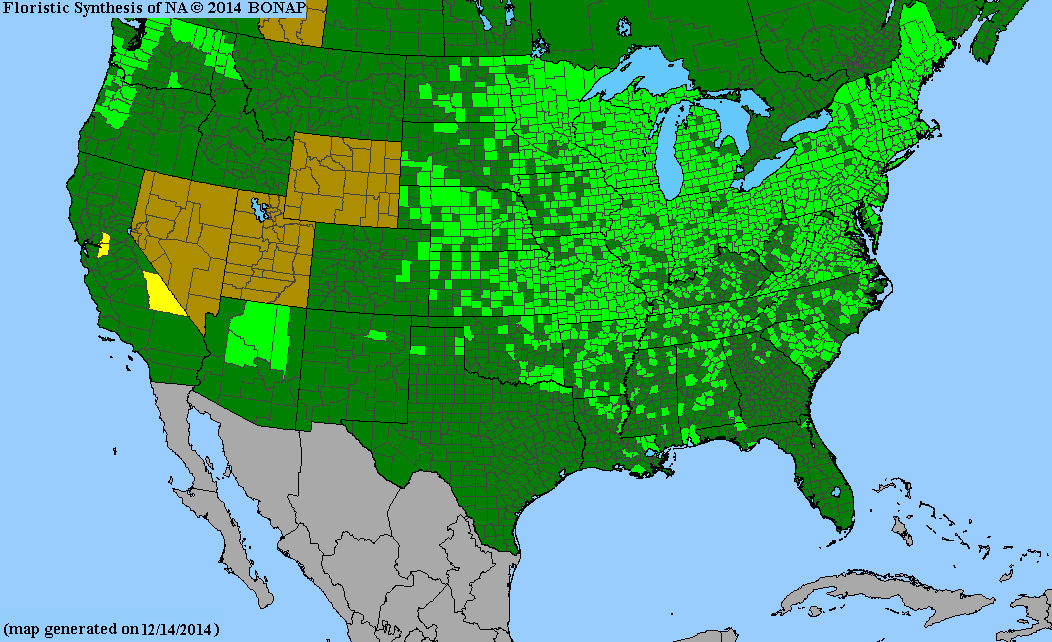
BONAP Range Map:
SE Michigan Monthly Observations:
Previously Known As:
Cassida lateriflora, Scutellaria polybotrya
Common Names:
mad-dog skullcap, blue skullcap, madweed, hooded willow herb, side-flowering skullcap, American skullcap, mad dog weed, hoodwort, helmet flower
Coefficient of Conservatism (C):
5.0
— Prefers natural areas
This plant does best in natural areas but can handle some changes to its environment. Finding it suggests the habitat is in decent shape.
Explained
Coefficient of Wetness (CW):
-5.0
— Loves wet feet
This plant almost always grows in wetlands. It thrives standing in water or saturated soil.
Explained
Similar Species / Distinguishing Features:(ⓘ Prompt)
• Native — Common skullcap (Scutellaria galericulata) is the most likely confusion species. It grows in similar wet habitats but prefers more open areas while mad-dog skullcap prefers shaded spots. Common skullcap has larger flowers and different leaf shapes. Hybrids between these two species (S. × churchilliana) have been found in Michigan's Upper Peninsula, with intermediate leaf shapes and flower sizes around 10-12 mm.
• Native — Marsh skullcap (Scutellaria galericulata) has larger flowers (compared to mad-dog skullcap's ¼ to ⅓ inch flowers), with more pronounced white lower lips covered in blue spots. Marsh skullcap leaves are narrower, stiffer, and stalkless or nearly stalkless, while mad-dog skullcap has broader, thinner leaves on stalks up to 1 inch long. Marsh skullcap flowers are borne in pairs from leaf axils rather than in the abundant axillary racemes typical of mad-dog skullcap.
Based on genus patterns: Other Scutellaria species can be confused with S. lateriflora, particularly S. galericulata (marsh skullcap) which has larger, more prominent flowers and broader leaves. Based on family patterns: Other square-stemmed mint family members like Prunella vulgaris (self-heal) differ by having dense terminal flower spikes rather than one-sided lateral clusters. Lycopus species (bugleweed) are distinguished by their tiny white flowers and deeply lobed leaves. Based on general practice: Agastache species may cause confusion but typically have much more aromatic foliage and larger, showier flower spikes.
Wikipedia Summary:
Scutellaria lateriflora, known commonly as blue skullcap, mad dog skullcap, and side-flowering skullcap, is a hardy perennial herb of the mint family, Lamiaceae, native to North America.