Narrowleaf Blue-eyed Grass
Sisyrinchium angustifolium
Species Identification
Information needed to identify the plant in the field
Native-MIFlora:
Native
Duration:
perennial
Height:
.5'
Stature:
Ankle
Bloom Color:
Blue
Compact Bloom Range:
MAY - JUN
Light:
Sn, P
Moisture:
M, Ms
Michigan Flora Description:
Moist shores, meadows, fields, thickets, and swales; oak-hickory forests, forest borders, grassy clearings. The commonest speciest in southernmost Michigan. This is normally distinctive and easy to recognize with the combination of broadly winged stems and branched inflorescences. Plants with simple stems and sessile spathes belong here if the stems are very broadly winged (> ca. 3 mm). Rare plants that do not seem to darken on drying may be distinguished from Sisyrinchium strictum by their wider stems (> 2.5 or more usually 3 mm), strongly unequal spathe bracts, and no tendency for peduncles and spathes to be geniculate at base. Usually a lax, leafy, and rather pale flowered plant, less showy than most species.
Germination Ecology / Real-World Behavior:(ⓘ Prompt)
Seeds develop from late spring through summer in small three-chambered capsules that turn brown and split open when mature, releasing small black seeds that can disperse short distances by wind. The seeds likely have physical dormancy from hard seed coats that need to be broken down by natural weathering over winter, allowing germination to occur the following spring after soil temperatures warm.
Based on genus patterns: Seeds are dispersed from small capsules in mid to late summer and typically exhibit physiological dormancy requiring a period of cold-moist stratification. Based on family patterns: Like many Iridaceae, seeds generally need 60-90 days of winter chilling to break dormancy. Based on life-history patterns: Natural germination occurs in spring following snowmelt, with seedlings emerging as soil temperatures warm but while moisture remains adequate from spring rains.
Habitat Notes:(ⓘ Prompt)
Stout blue-eyed grass grows in moist shores, meadows, fields, thickets, and swales throughout Michigan, as well as in oak-hickory forests, forest borders, and grassy clearings. It's the most common blue-eyed grass species in southern Michigan. The plant produces vibrant blue-purple six-pointed flowers followed by three-parted seed capsules (beaks) containing tiny black seeds. When the seeds are mature, the capsules split open like a beak to release the seeds, allowing them to scatter nearby.
Go Botany confirms habitat in meadows, fields, and wetland edges. Illinois Wildflowers adds that it occurs in floodplain forests, woodland borders and openings, moist oak savannas, and river slopes, preferring grassy areas where broad-leaved plants won't crowd it out. The seeds can be carried short distances by wind gusts after the three-celled capsules split into three sections.
Based on species patterns: Blue-eyed grass grows in moist to wet meadows, prairies, sedge meadows, and open areas with consistent moisture throughout the growing season. It tolerates both full sun and partial shade but requires good drainage despite preferring moist conditions. Based on genus patterns: The small, dark seeds develop in three-chambered capsules that split open when mature, releasing seeds directly below the parent plant or allowing them to be dispersed short distances by wind and surface water flow. Seeds may also be moved by animals brushing against the dried seed heads or through mud adherence to feet and fur.
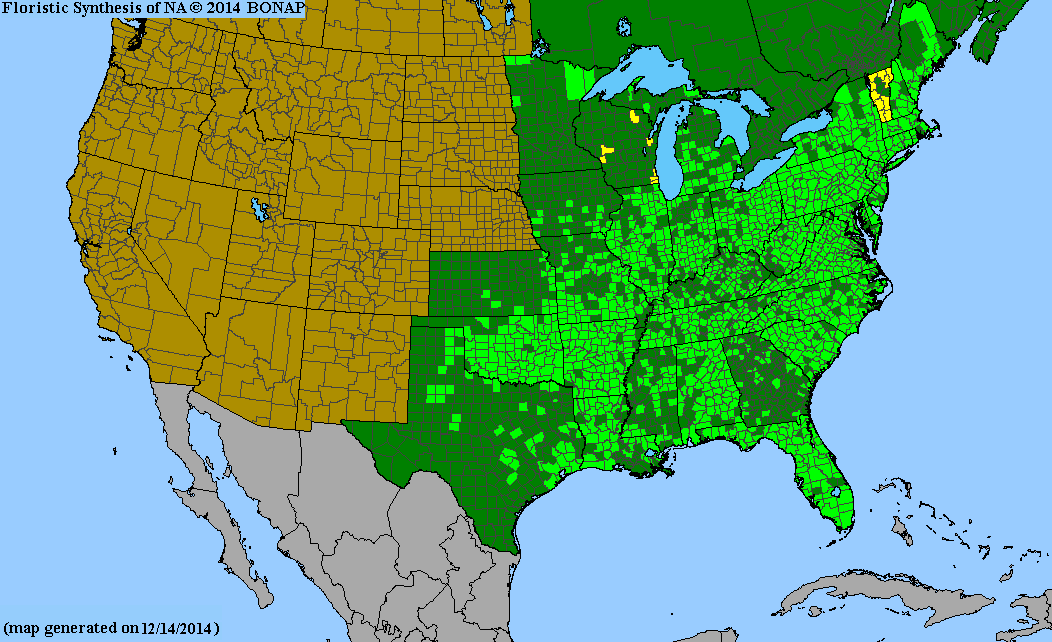
BONAP Range Map:
SE Michigan Monthly Observations:
External Reference URLs:
Previously Known As:
Bermudiana angustifolia, Bermudiana graminea, Bermudiana graminea, Bermudiana graminifolia, Bermudiana homomalla, Bermudiana iridifolia, Ferraria pulchella, Ferraria violacea, Marica mucronata, Marica mucronata, Sisyrinchium acuminatum, Sisyrinchium anceps
Common Names:
narrow-leaved blue-eyed grass, blue-eyed grass, narrow-leaf blue-eyed grass, pointed blue-eyed grass, stout blue-eyed grass
Coefficient of Conservatism (C):
4.0
— Prefers natural areas
This plant does best in natural areas but can handle some changes to its environment. Finding it suggests the habitat is in decent shape.
Explained
Similar Species / Distinguishing Features:(ⓘ Prompt)
• Native — **Sisyrinchium atlanticum** (Atlantic blue-eyed grass): stems much thinner (0.8-1.9 mm wide) with narrow wing margins vs. S. angustifolium's wider stems (2.3-5 mm) with conspicuous wing margins.
• Native — **Sisyrinchium albidum** (white blue-eyed grass): produces 2-5 inflorescences on branch-like stalks with white or pale violet flowers, vs. S. angustifolium's single paired inflorescences at stem tip with blue to purple flowers.
• Native — **Sisyrinchium montanum** (common blue-eyed grass): has slightly wider leaves (over 6 mm) and unbranched flower stalks, vs. S. angustifolium's narrower leaves and occasionally branched stalks.
• Native — **Sisyrinchium albidum** (white blue-eyed grass): produces 2-5 inflorescences on branch-like stalks with white or pale violet flowers, vs. S. angustifolium's single paired inflorescences at stem tip with blue to purple flowers.
• Native — **Sisyrinchium montanum** (common blue-eyed grass): has slightly wider leaves (over 6 mm) and unbranched flower stalks, vs. S. angustifolium's narrower leaves and occasionally branched stalks.
• Based on genus patterns: Other Sisyrinchium species are the most common source of confusion, particularly S. montanum (strict blue-eyed grass) which has broader leaves and typically grows in drier sites, and S. mucronatum (needle-tip blue-eyed grass) which has pointed leaf tips. Based on family patterns: Iris family members like young Iris versicolor (blue flag iris) shoots can be confused in early growth stages, but iris develops much broader, flatter leaves. Based on general pattern recognition: Grass-like sedges such as Carex species may be confused when not flowering, but sedges have three-ranked leaves and triangular stems versus the flat, two-ranked leaves of Sisyrinchium.
• Non-native — Small iris cultivars in landscaping may appear similar but typically have much more robust growth and broader leaves.
• Non-native — Small iris cultivars in landscaping may appear similar but typically have much more robust growth and broader leaves.
Wikipedia Summary:
Sisyrinchium angustifolium, commonly known as narrow-leaf blue-eyed-grass, is a herbaceous perennial growing from rhizomes, native to moist meadow and open woodland. It is the most common blue-eyed grass of the eastern United States, and is also cultivated as an ornamental.
Cloudinary Images - Identification
3 images

