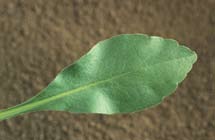
Showy Goldenrod
Solidago speciosa
Species Identification
Information needed to identify the plant in the field
Native-MIFlora:
Native
Duration:
perennial
Height:
2'-5'
Stature:
Chest
Bloom Color:
Yellow
Compact Bloom Range:
AUG - OCT
Light:
Sn
Moisture:
D, M
Michigan Flora Description:
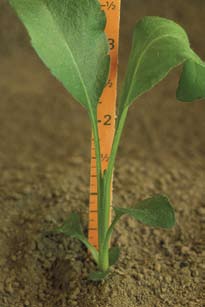
Dry open sandy ground, including oak and jack pine savannas, prairies, fields, rarely dunes, and associated roadsides and railroads; thin soil on high rock mountains in the western Upper Peninsula. This is another variable species, but well named for its large showy inflorescences late in the season. In the southern part of the Lower Peninsula and apparently also in the western Upper Peninsula is var. speciosa , with basal leaves running 3–8 cm broad. Less robust plants, with fewer and narrower leaves, blooming earlier, are var. jejunifolia (E. S. Steele) Cronquist; these plants range south through the jack pine plains from Cheboygan Co., whence they were first described, into the range of var. speciosa , and also locally in the Upper Peninsula. The separation of varieties is not always clear, especially since the basal leaves often wither by flowering time. Rarely, a plant of S. juncea has branches of the inflorescence not one-sided, and such plants are likely to run here in the key because of their larger lower leaves, glabrous or glabrate stems, and small heads. In S. juncea , at least the lower leaves are ± strongly toothed, and the inflorescence is predominantly terminal (even vase-like).
Germination Ecology / Real-World Behavior:(ⓘ Prompt)
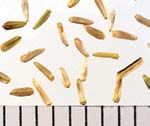
Showy goldenrod seeds disperse in fall when mature achenes (small dry seeds) with fluffy pappus tufts are carried by wind. The seeds have physiological dormancy that requires cold stratification to break - they need a period of cold, moist conditions over winter to germinate the following spring. Seeds naturally germinate in spring after experiencing winter's cold treatment, with some sources noting stratification may increase germination rates though it's not absolutely required if seeds are fresh.
Based on genus patterns: Seeds disperse in late fall through early winter via wind-carried pappus, typically after several hard frosts. Based on family patterns: Seeds exhibit physiological dormancy requiring cold-moist stratification to break internal biochemical barriers. Based on genus patterns: Natural germination occurs in spring after 90-120 days of winter conditioning, with germination triggered by warming soil temperatures and increasing day length. Based on general practice: Seeds are capable of delayed germination, with some remaining dormant through the first favorable season and germinating in subsequent years.
Habitat Notes:(ⓘ Prompt)
Showy goldenrod grows in dry open sandy ground including oak and jack pine savannas, prairies, and fields in Michigan. It can also be found on roadsides and railroads with similar conditions. The seeds have fluffy attachments called pappus (fluffy seed tuft) that allow wind to efficiently move them over long distances. When the seeds mature and become fluffy, they are released from the flower heads and carried by air currents to new locations where they can establish in suitable sandy, well-drained habitats.
Based on species patterns: Solidago speciosa typically inhabits prairie remnants, oak savannas, and dry to mesic grasslands across southeastern Michigan. Based on genus patterns: Like other goldenrods, it produces small achenes (dry seeds) topped with white pappus bristles that enable wind dispersal. Seeds mature in late summer to early fall when the fluffy pappus structures catch autumn winds, carrying seeds away from the parent plant to establish new colonies. Based on family patterns: The pappus remains attached through winter, allowing for extended dispersal periods during windy conditions.
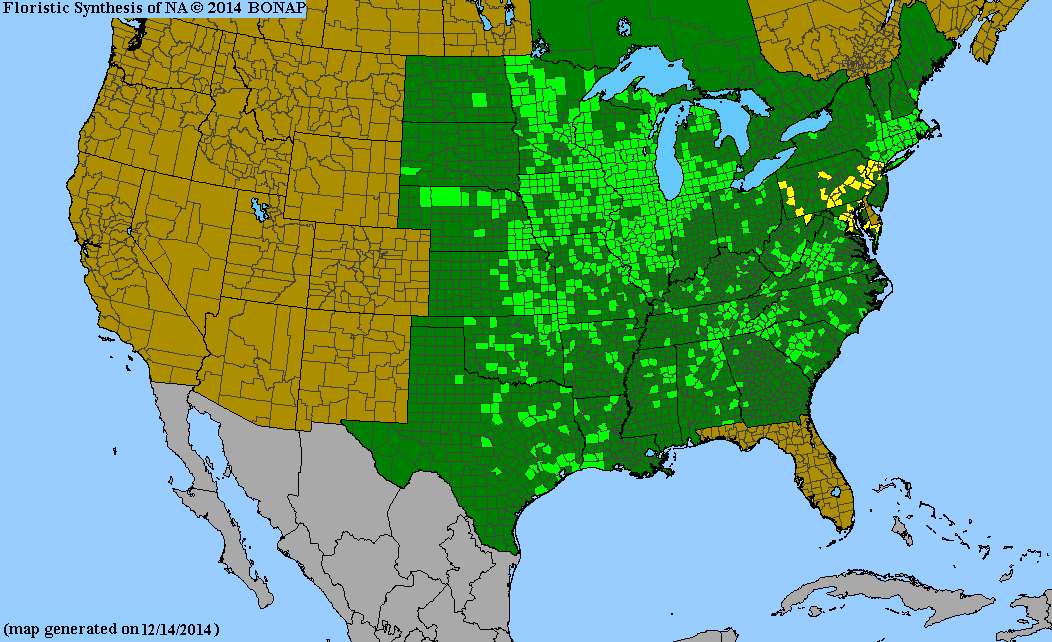
BONAP Range Map:
SE Michigan Monthly Observations:
Previously Known As:
Aster speciosus, Leioligo speciosa, Solidago conferta, Solidago erecta, Solidago harperi
Common Names:
showy goldenrod, noble goldenrod
Coefficient of Conservatism (C):
5.0
— Prefers natural areas
This plant does best in natural areas but can handle some changes to its environment. Finding it suggests the habitat is in decent shape.
Explained
Coefficient of Wetness (CW):
5.0
— Needs dry ground
This plant almost never grows in wetlands. It needs well-drained soil and can rot in soggy conditions.
Explained
Similar Species / Distinguishing Features:(ⓘ Prompt)
• Native — Solidago juncea (Early Goldenrod) can occasionally be confused with showy goldenrod when its flower clusters are not one-sided, but early goldenrod has strongly toothed lower leaves and a predominantly terminal, vase-like flower arrangement.
• Native — Solidago uliginosa (Bog Goldenrod) may be confused with showy goldenrod in herbarium specimens, but their habitats easily separate them in the wild since bog goldenrod grows in wet areas while showy goldenrod prefers dry, sandy ground.
• Native — Solidago uliginosa (Bog Goldenrod) may be confused with showy goldenrod in herbarium specimens, but their habitats easily separate them in the wild since bog goldenrod grows in wet areas while showy goldenrod prefers dry, sandy ground.
• Native — Solidago rigidiuscula (Stiff Goldenrod) is very similar but has narrower basal leaves (up to ¾ inch wide vs. up to 2 inches), more crowded and stiff stem leaves, and may not have persistent basal leaves at flowering time.
• Native — Solidago jejunifolia (Prairie Goldenrod) also closely resembles showy goldenrod but has fewer and narrower leaves overall.
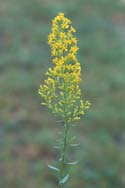
• Native — Other goldenrods can be distinguished by their drooping or pyramidal flower clusters, while showy goldenrod maintains erect, cylindrical clusters with branches that curve upward rather than outward and downward.
• Native — Solidago jejunifolia (Prairie Goldenrod) also closely resembles showy goldenrod but has fewer and narrower leaves overall.
• Native — Other goldenrods can be distinguished by their drooping or pyramidal flower clusters, while showy goldenrod maintains erect, cylindrical clusters with branches that curve upward rather than outward and downward.
• Based on genus patterns:
• Native — Solidago rigida (stiff goldenrod) has similar flat-topped flower clusters but broader, more oval leaves and typically shorter stature.
• Native — Solidago riddellii (Riddell's goldenrod) also forms flat clusters but has very narrow, grass-like leaves.
• Native — Solidago canadensis (Canada goldenrod) has pyramidal rather than flat-topped flower arrangements.
• Native — Solidago nemoralis (gray goldenrod) is much shorter with smaller, more compact flower clusters.
• Native — Euthamia graminifolia (flat-top goldentop) has linear leaves and similar flat clusters but is typically found in wetter sites. Based on family patterns:
• Non-native — Tanacetum vulgare (common tansy) has similar flat-topped yellow flower clusters but compound, ferny leaves with a strong aromatic scent.
• Native — Solidago rigida (stiff goldenrod) has similar flat-topped flower clusters but broader, more oval leaves and typically shorter stature.
• Native — Solidago riddellii (Riddell's goldenrod) also forms flat clusters but has very narrow, grass-like leaves.
• Native — Solidago canadensis (Canada goldenrod) has pyramidal rather than flat-topped flower arrangements.
• Native — Solidago nemoralis (gray goldenrod) is much shorter with smaller, more compact flower clusters.
• Native — Euthamia graminifolia (flat-top goldentop) has linear leaves and similar flat clusters but is typically found in wetter sites. Based on family patterns:
• Non-native — Tanacetum vulgare (common tansy) has similar flat-topped yellow flower clusters but compound, ferny leaves with a strong aromatic scent.
Wikipedia Summary:
Solidago speciosa, the showy goldenrod, is a North American species of flowering plants in the sunflower family. It grows in the province of Ontario in central Canada, as well as in the eastern and central United States (from the Atlantic coast west as far as the Great Plains, so from Maine to Georgia (except Delaware) west as far as Texas, Nebraska, and the Dakotas).
Cloudinary Images - Identification
8 images