Smooth/Smooth Blue Aster
Symphyotrichum laeve
Species Identification
Information needed to identify the plant in the field
Native-MIFlora:
Native
Duration:
perennial
Height:
1'-3'
Stature:
Waist
Bloom Color:
Lt. Blue-Lavender
Compact Bloom Range:
SEP - OCT
Light:
Sn, P
Moisture:
D, M, Ms
Michigan Flora Description:
Aster laevis of Michigan Flora Dry open forests (oak, aspen, jack pine) and thickets, especially at borders and clearings; fields and roadsides; sandy plains, bluffs, stabilized dunes; prairies, meadows, shores; sometimes in wet places, especially fens. In its relatively few, large (long-rayed) heads this species somewhat resembles S. ciliolatum ; furthermore, sometimes broad leaves below the middle of the stem taper to the base, even appearing to have narrowly to broadly winged petioles; however, S. ciliolatum does not have the clasping leaf bases so characteristic of S. laeve . The species is quite variable in leaf shape and number of heads. Also, some plants have long-creeping rhizomes, while others have only a short perennial base. The species might repay more detailed study.
Germination Ecology / Real-World Behavior:(ⓘ Prompt)
Seeds disperse in fall and winter with fluffy hair tufts (pappus) that carry them on wind. The seeds have physiological dormancy and require cold stratification - a period of cold, moist conditions - to break dormancy and prepare for germination. In nature, seeds experience this cold treatment over winter when they remain on the soil surface under snow. Seeds typically germinate in spring after winter stratification, though some may delay germination for a year or more. This dormancy mechanism prevents all seeds from germinating at once before potential killing frosts or during unfavorable conditions.
Based on genus patterns: Seeds disperse in late fall through early winter via wind-carried pappus, with peak dispersal occurring after seed heads fully mature and dry. Based on family patterns: Seeds exhibit physiological dormancy typical of Asteraceae, requiring cold-moist stratification to break dormancy and synchronize germination. Based on general practice: Natural germination occurs in spring after winter stratification, with seeds responding to warming soil temperatures and increasing day length. Germination is typically light-dependent, occurring at or near the soil surface rather than when deeply buried.
Habitat Notes:(ⓘ Prompt)
Smooth blue aster grows in dry open forests including oak, aspen, and jack pine stands, especially at forest borders and clearings. It thrives in sandy plains, bluffs, stabilized dunes, prairies, meadows, and shores, and can also be found along fields and roadsides. The species prefers mesic to dry prairies and inhabits sunny openings in savannas. Seeds are dispersed by wind through fluffy white pappus (seed tuft) that is often tinged with amber or rose color, allowing the lightweight seeds to travel long distances on air currents.
The species also grows in rocky woodlands, woodland edges, thickets, limestone glades, hill prairies, and sandy woodlands. It typically occurs in higher quality natural areas where the original ground flora is intact. The plant grows in anthropogenic habitats including human-disturbed areas and roadside embankments. Smooth blue aster prefers full to partial sun with mesic soil conditions containing loam, clay-loam, sandy loam, or rocky material, and can tolerate hot dry weather if not too prolonged.
Based on species patterns: Symphyotrichum laeve typically inhabits prairies, open woodlands, and disturbed sites with well-drained to moderately dry soils in full sun to partial shade. Based on family patterns: Seeds are small achenes topped with white pappus that enables wind dispersal. Based on genus patterns: The fluffy pappus structures catch autumn winds, carrying seeds away from parent plants during late fall and early winter, with seeds settling in open areas where they undergo natural cold stratification through winter months.
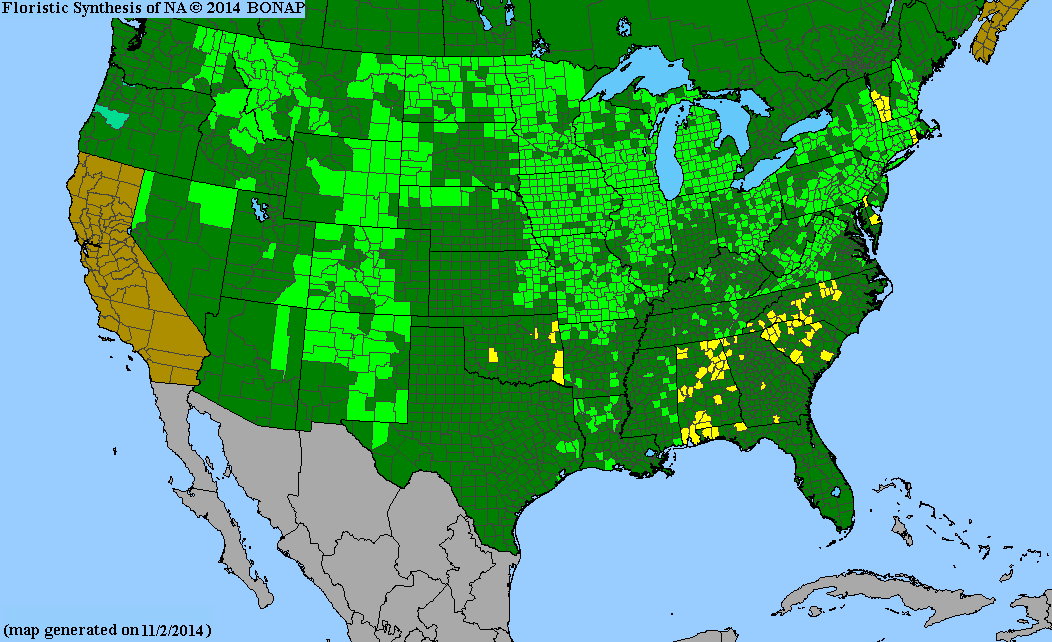
BONAP Range Map:
SE Michigan Monthly Observations:
Previously Known As:
Aster amplexicaulis, Aster amplexicaulis, Aster autranii, Aster bupleurifolius, Aster cyaneus, Aster decorus, Aster decorus, Aster expansus, Aster falcidens, Aster glaucescens, Aster glaucescens, Aster glaucus, Aster laevigatus, Aster laevis
Common Names:
smooth aster, smooth blue aster, smooth-leaved aster, glaucous aster, prairie aster
Coefficient of Conservatism (C):
5.0
— Prefers natural areas
This plant does best in natural areas but can handle some changes to its environment. Finding it suggests the habitat is in decent shape.
Explained
Coefficient of Wetness (CW):
3.0
— Prefers dry conditions
This plant usually grows in well-drained, drier upland areas and may struggle in wet soils.
Explained
Similar Species / Distinguishing Features:(ⓘ Prompt)
• Native — Symphyotrichum ciliolatum (Lindley's aster): Both have relatively few, large flower heads with long rays, but S. ciliolatum lacks the clasping leaf bases that are characteristic of smooth blue aster.
• Native — Symphyotrichum oolentangiense (sky blue aster): Both bloom at the same time and grow in similar habitats, but sky blue aster has smaller flowers (less than 1 inch across), leaves that are arrowhead-shaped near the base and do not clasp the stem, and rough-textured rather than smooth leaves.
• Based on genus patterns:
• Native — Symphyotrichum ericoides (aromatic aster) has much smaller, more numerous white flowers and narrow linear leaves.
• Native — Symphyotrichum pilosum (frost aster) has hairy stems and leaves versus the smooth character of S. laeve.
• Native — Symphyotrichum novae-angliae (New England aster) typically has purple flowers and clasping leaves.
• Native — Symphyotrichum oblongifolium (aromatic aster) has smaller blue-purple flowers and more oblong leaves. Based on family patterns:
• Non-native — Symphyotrichum x salignum (willow aster, hybrid) may have similar smooth appearance but typically shows intermediate characteristics. Based on general practice: Many Symphyotrichum species hybridize readily, making field identification challenging without close examination of leaf attachment, stem texture, and flower size.
• Native — Symphyotrichum ericoides (aromatic aster) has much smaller, more numerous white flowers and narrow linear leaves.
• Native — Symphyotrichum pilosum (frost aster) has hairy stems and leaves versus the smooth character of S. laeve.
• Native — Symphyotrichum novae-angliae (New England aster) typically has purple flowers and clasping leaves.
• Native — Symphyotrichum oblongifolium (aromatic aster) has smaller blue-purple flowers and more oblong leaves. Based on family patterns:
• Non-native — Symphyotrichum x salignum (willow aster, hybrid) may have similar smooth appearance but typically shows intermediate characteristics. Based on general practice: Many Symphyotrichum species hybridize readily, making field identification challenging without close examination of leaf attachment, stem texture, and flower size.
Wikipedia Summary:
Symphyotrichum laeve (smooth blue aster, smooth aster, smooth-leaved aster, glaucous Michaelmas-daisy or glaucous aster) is a flowering plant native to Canada and the United States.
Cloudinary Images - Identification
3 images

