Calico Aster
Symphyotrichum lateriflorum
Species Identification
Information needed to identify the plant in the field
Native-MIFlora:
Native
Duration:
perennial
Height:
2'
Stature:
Knee
Bloom Color:
White
Compact Bloom Range:
AUG - OCT
Light:
Sn, P, Sh
Moisture:
M, Ms
Michigan Flora Description:
Aster lateriflorus of Michigan Flora . Usually in ± shaded ground, including forests (beech-maple, oak-hickory, mixed hardwood and conifers), thickets, borders and clearings, swamps (conifers or hardwoods); floodplains, river banks, ravines, rocky banks and openings; also meadows, shores, and roadsides, mostly along the edges; less commonly in peatlands. Ordinarily well distinguished by the deeply lobed disk corollas, which all turn rosy early in anthesis (unlike most asters, before starting to wither); leaves with only the midrib hairy beneath; ± one-sided racemose branches of the inflorescence; and stems arising from a short perennial base rather than being colonial from an elongate rhizome. The rather slender stems vary from glabrous to pubescent and are often branched or sprawling from the lower nodes. Leaves vary from linear and entire to elliptic and toothed. Pedicel length varies. Names have been published for some of these intergrading variants. The basal leaves, when present, have relatively broad elliptic or rotund blades. The contrasting white rays, still fresh when the disks are rosy purple, are presumably the source of the common name.
Germination Ecology / Real-World Behavior:(ⓘ Prompt)
Seeds are dispersed in late fall after frost turns the disk flowers from pale yellow to purplish-red or brown. The small seeds have tufts of white to pinkish bristles that help them disperse by wind. Seeds likely have some dormancy mechanisms typical of fall-dispersing asters, requiring cold winter conditioning before germinating in spring or early summer when soil temperatures warm.
Based on genus patterns: Seeds disperse in late fall to early winter when mature achenes with white pappus are released from dried flower heads. Based on family patterns: Seeds typically exhibit physiological dormancy common in Asteraceae, requiring cold-moist stratification to break dormancy mechanisms. Based on genus patterns: Natural germination occurs in spring following winter's cold treatment, with seedlings emerging as soil warms in late spring to early summer. Light is typically required for germination, reflecting the pioneer nature of most asters. Based on general practice: Seeds that disperse in fall remain dormant through winter, with germination triggered by warming temperatures and longer photoperiods in spring.
Habitat Notes:(ⓘ Prompt)
Calico aster grows in a wide range of habitats across Southeast Michigan, from shaded forests to sunny edges. It's found in beech-maple and oak-hickory forests, thickets, swamps, floodplains, and along riverbanks, but also thrives in meadows, shores, and roadsides, usually along the edges rather than deep shade or full sun. The plant prefers wet to dry-mesic conditions and can adapt to both woodlands and sunny areas. Like other asters, calico aster produces fluffy seeds with pappus (fluffy seed tufts) that catch the wind for efficient long-distance dispersal. When the seeds mature and become fluffy, wind carries them away from the parent plant to establish new populations in suitable habitats.
Fields, thickets, and clearings are important habitats not captured in the Tier 1 response, showing calico aster's adaptability to more open disturbed areas beyond woodland edges. The plant specifically favors areas with a history of disturbance and can tolerate full sun if moisture is adequate, though it performs best in light shade to partial sun with moist, rich organic soil or moisture-retaining clay-loam. During dry periods, lower leaves often wither, making the plant appear stressed. The seeds are small cypselae (achenes) with dull white to pinkish hair tufts that enable wind dispersal, and the plant can form colonies through both seed dispersal and rhizomatous spread with clonal offsets.
Based on species patterns: Symphyotrichum lateriflorum typically grows in partially shaded to open areas including woodland edges, disturbed sites, and along pathways. Based on genus patterns: It tolerates a range of soil conditions from moist to moderately dry and can establish in both natural and human-modified landscapes. Based on family patterns: Seeds are small achenes topped with white pappus bristles that enable wind dispersal. The pappus acts like a parachute, allowing seeds to drift away from the parent plant on autumn breezes. Based on general practice: This dispersal strategy helps the species colonize new disturbed sites and maintain populations across fragmented habitats.
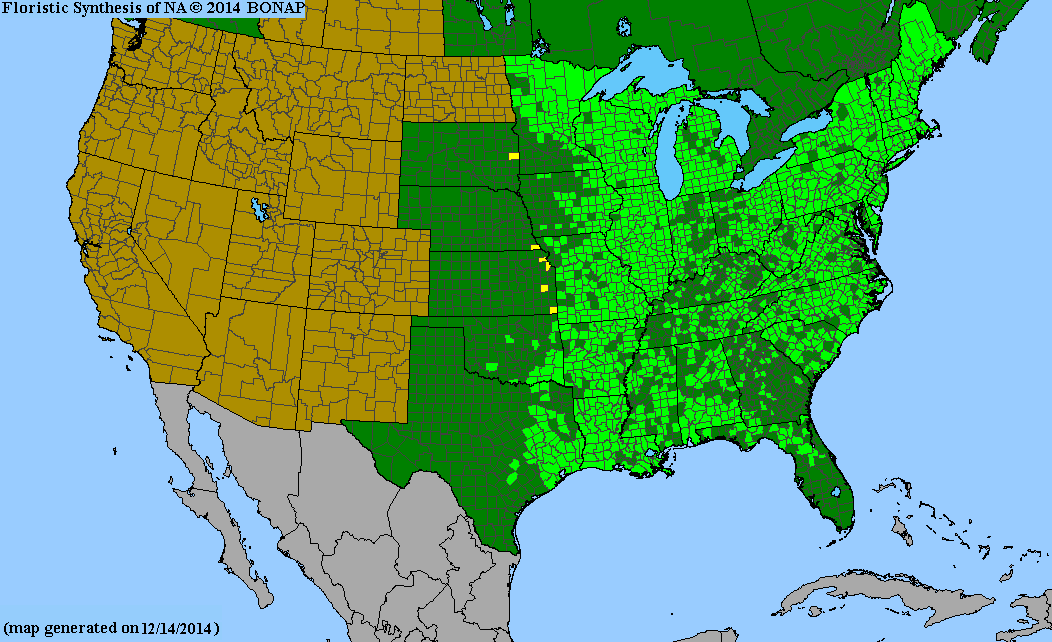
BONAP Range Map:
SE Michigan Monthly Observations:
Previously Known As:
Aster acadiensis, Aster agrostifolius, Aster bifrons, Aster bifrons, Aster diffusus, Aster divaricatus, Aster divaricatus, Aster divergens
Common Names:
calico aster, side-flowering aster, starved aster, farewell summer, white woodland aster, goblet aster
Coefficient of Conservatism (C):
2.0
— Adaptable
This plant can grow in many different settings, including areas that have been somewhat changed by human activity.
Explained
Similar Species / Distinguishing Features:(ⓘ Prompt)
• Native — Symphyotrichum pilosum (frost aster) has more ray flowers (15+ vs 9-16), brighter yellow disk centers, and grows in more open prairie habitats rather than woodland edges.
• Native — Symphyotrichum ericoides (heath aster) is more compact with shorter, narrower leaves and typically found in open prairies rather than semi-shaded areas.
• Native — Symphyotrichum lanceolatum (panicled aster) has more ray flowers (15+), brighter yellow disks, and hairless leaves except along margins.
• Native — Symphyotrichum boreale (northern bog aster) has more ray flowers (15+), brighter yellow disks, and hairless leaves except along edges.
• Native — Symphyotrichum ontarionis (Ontario aster) may have similar branching and hairy stems, but has hairs on leaf surfaces rather than just along the midvein.
• Native — Symphyotrichum ericoides (heath aster) is more compact with shorter, narrower leaves and typically found in open prairies rather than semi-shaded areas.
• Native — Symphyotrichum lanceolatum (panicled aster) has more ray flowers (15+), brighter yellow disks, and hairless leaves except along margins.
• Native — Symphyotrichum boreale (northern bog aster) has more ray flowers (15+), brighter yellow disks, and hairless leaves except along edges.
• Native — Symphyotrichum ontarionis (Ontario aster) may have similar branching and hairy stems, but has hairs on leaf surfaces rather than just along the midvein.
• Based on genus patterns: Other Symphyotrichum species with small white flowers and similar fall blooming periods are commonly confused with S. lateriflorum.
• Native — Symphyotrichum ericoides (aromatic aster) has smaller, more densely clustered flowers and typically grows in drier sites.
• Native — Symphyotrichum pilosum (frost aster) has hairier stems and leaves with more pronounced pubescence.
• Native — Symphyotrichum racemosum (smooth white oldfield aster) tends to have more open branching and smoother foliage. Based on family patterns: Other fall-blooming white Asteraceae may cause confusion, particularly
• Native — Solidago species (goldenrods) when flowers appear whitish, though these typically have yellow flower heads.
• Native — Eurybia species (aromatic asters) may overlap in habitat but typically have broader leaves and different growth forms.
• Native — Symphyotrichum ericoides (aromatic aster) has smaller, more densely clustered flowers and typically grows in drier sites.
• Native — Symphyotrichum pilosum (frost aster) has hairier stems and leaves with more pronounced pubescence.
• Native — Symphyotrichum racemosum (smooth white oldfield aster) tends to have more open branching and smoother foliage. Based on family patterns: Other fall-blooming white Asteraceae may cause confusion, particularly
• Native — Solidago species (goldenrods) when flowers appear whitish, though these typically have yellow flower heads.
• Native — Eurybia species (aromatic asters) may overlap in habitat but typically have broader leaves and different growth forms.
Wikipedia Summary:
Symphyotrichum lateriflorum (common name calico aster or starved aster) is a species of flowering plant in the daisy family Asteraceae, native to eastern North America. In the British Isles it is still widely referenced under its old name, Aster lateriflorus syn. A. diffusus, A. vimineus.
Cloudinary Images - Identification
3 images

